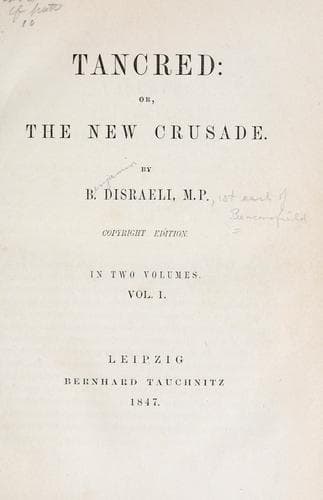
Tancred; Or, The New CrusadeDisraeli, Benjamin, Earl of Beaconsfield
ReligionJewish
Tancred; Or, The New Crusade
Disraeli, Benjamin, Earl of Beaconsfield
Christianity and other religions -- Judaism -- Fiction; Judaism -- Relations -- Christianity -- Fiction
‘If a Parliamentary career could save this country,’ said Tancred, ‘I
am sure you would be a public benefactor. I have observed what you and
Mr. Con-ingsby and some of your friends have done and said, with great
interest. But Parliament seems to me to be the very place which a man
of action should avoid. A Parliamentary career, that old superstition of
the eighteenth century, was important when there were no other sources
of power and fame. An aristocracy at the head of a people whom they had
plundered of their means of education, required some cultivated tribunal
whose sympathy might stimulate their intelligence and satisfy their
vanity. Parliament was never so great as when they debated with closed
doors. The public opinion, of which they never dreamed, has superseded
the rhetorical club of our great-grandfathers. They know this well
enough, and try to maintain their unnecessary position by affecting
the character of men of business, but amateur men of business are very
costly conveniences. In this age it is not Parliament that does the real
work. It does not govern Ireland, for example. If the manufacturers want
to change a tariff, they form a commercial league, and they effect their
purpose. It is the same with the abolition of slavery, and all our great
revolutions. Parliament has become as really insignificant as for two
centuries it has kept the monarch. O’Connell has taken a good share of
its power; Cobden has taken another; and I am inclined to believe,’
said Tancred, ‘though I care little about it, that, if our order had
any spirit or prescience, they would put themselves at the head of the
people, and take the rest.’
‘Coningsby dines here to-day,’ said Sidonia, who, unobserved, had
watched Tancred as he spoke, with a searching glance.
‘Notwithstanding what you say,’ said Lord Henry, smiling, ‘I wish I
could induce you to remain and help us. You would be a great ally.’
‘I go to a land,’ said Tancred, ‘that has never been blessed by that
fatal drollery called a representative government, though Omniscience
once deigned to trace out the polity which should rule it.’
At this moment the servant announced Lord and Lady Marney.
Political sympathy had created a close intimacy between Lord Marney
and Coningsby. They were necessary to each other. They were both men
entirely devoted to public affairs, and sitting in different Houses,
both young, and both masters of fortunes of the first class, they were
indicated as individuals who hereafter might take a lead, and, far
from clashing, would co-operate with each other. Through Coningsby
the Marneys had become acquainted with Sidonia, who liked them both,
particularly Sybil. Although received by society with open arms,
especially by the high nobility, who affected to look upon Sybil quite
as one of themselves, Lady Marney, notwithstanding the homage that
everywhere awaited her, had already shown a disposition to retire as
much as possible within the precinct of a chosen circle.
Public-domain text, read in full here on John Shaqi.
Reviews
Reviews
No reviews yet
Be the first to share your thoughts on this work.
Elsewhere in the archive
Join the Discussion
Join the discussion
Sign in to leave a comment or review.
Sign InorCreate an account