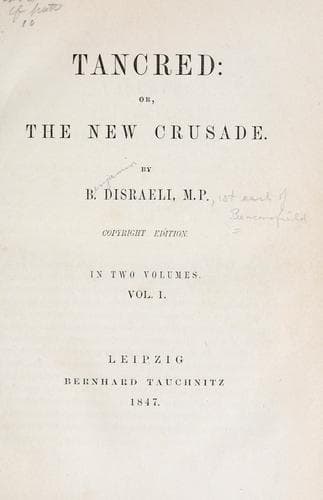
Tancred; Or, The New CrusadeDisraeli, Benjamin, Earl of Beaconsfield
ReligionJewish
Tancred; Or, The New Crusade
Disraeli, Benjamin, Earl of Beaconsfield
Christianity and other religions -- Judaism -- Fiction; Judaism -- Relations -- Christianity -- Fiction
‘Yes, but what is progressive development?’ said Sidonia; ‘and what are
the faculties of man? If development be progressive, how do you
account for the state of Italy? One will tell you it is superstition,
indulgences, and the Lady of Loretto; yet three centuries ago, when all
these influences were much more powerful, Italy was the soul of Europe.
The less prejudiced, a Puseyite for example, like our friend Vavasour,
will assure us that the state of Italy has nothing to do with the
spirit of its religion, but that it is entirely an affair of commerce; a
revolution of commerce has convulsed its destinies. I cannot forget that
the world was once conquered by Italians who had no commerce. Has the
development of Western Asia been progressive? It is a land of tombs and
ruins. Is China progressive, the most ancient and numerous of existing
societies? Is Europe itself progressive? Is Spain a tithe as great as
she was? Is Germany as great as when she invented printing; as she was
under the rule of Charles the Fifth? France herself laments her relative
inferiority to the past. But England flourishes. Is it what you
call civilisation that makes England flourish? Is it the universal
development of the faculties of man that has rendered an island, almost
unknown to the ancients, the arbiter of the world? Clearly not. It is
her inhabitants that have done this; it is an affair of race. A Saxon
race, protected by an insular position, has stamped its diligent and
methodic character on the century. And when a superior race, with
a superior idea to work and order, advances, its state will be
progressive, and we shall, perhaps, follow the example of the desolate
countries. All is race; there is no other truth.’
‘Because it includes all others?’ said Lord Henry.
‘You have said it.’
‘As for Vavasour’s definition of civilisation,’ said Coningsby,
‘civilisation was more advanced in ancient than modern times; then what
becomes of the progressive principle? Look at the great centuries of the
Roman Empire! You had two hundred millions of human beings governed by
a jurisprudence so philosophical that we have been obliged to adopt
its laws, and living in perpetual peace. The means of communication,
of which we now make such a boast, were far more vast and extensive in
those days. What were the Great Western and the London and Birmingham to
the Appian and Flaminian roads? After two thousand five hundred years,
parts of these are still used. A man under the Antonines might travel
from Paris to Antioch with as much ease and security as we go from
London to York. As for free trade, there never was a really unshackled
commerce except in the days when the whole of the Mediterranean coasts
belonged to one power. What a chatter there is now about the towns, and
how their development is cited as the peculiarity of the age, and the
great security for public improvement. Why, the Roman Empire was the
empire of great cities. Man was then essentially municipal.’
Public-domain text, read in full here on John Shaqi.
Reviews
Reviews
No reviews yet
Be the first to share your thoughts on this work.
Elsewhere in the archive
Join the Discussion
Join the discussion
Sign in to leave a comment or review.
Sign InorCreate an account