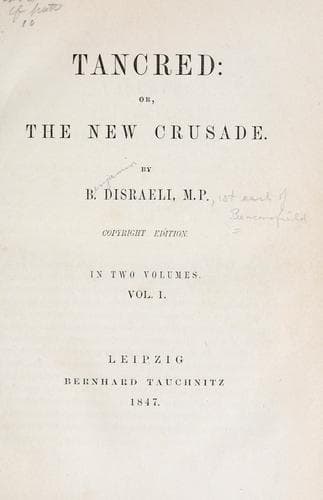
Tancred; Or, The New CrusadeDisraeli, Benjamin, Earl of Beaconsfield
ReligionJewish
Tancred; Or, The New Crusade
Disraeli, Benjamin, Earl of Beaconsfield
Christianity and other religions -- Judaism -- Fiction; Judaism -- Relations -- Christianity -- Fiction
THE sun had been declining for some hours, the glare of the earth had
subsided, the fervour of the air was allayed. A caravan came winding
round the hills, with many camels and persons in rich, bright Syrian
dresses; a congregation that had assembled at the Church of the
Ascension on Mount Olivet had broken up, and the side of the hill was
studded with brilliant and picturesque groups; the standard of the
Crescent floated on the Tower of David; there was the clang of Turkish
music, and the governor of the city, with a numerous cavalcade, might be
discerned on Mount Moriah, caracoling without the walls; a procession
of women bearing classic vases on their heads, who had been fetching
the waters of Siloah from the well of Job, came up the valley of
Jehosha-phat, to wind their way to the gate of Stephen and enter
Jerusalem by the street of Calvary.
Tancred came forth from the garden of Gethsemane, his face was flushed
with the rapt stillness of pious ecstasy; hours had vanished during his
passionate reverie, and he stared upon the declining sun.
‘The path to the right leads to Bethany.’ The force of association
brought back the last words that he had heard from a human voice.
And can he sleep without seeing Bethany? He mounts the path. What a
landscape surrounds him as he moves! What need for nature to be fair
in a scene like this, where not a spot is visible that is not heroic
or sacred, consecrated or memorable; not a rock that is not the cave of
prophets; not a valley that is not the valley of heaven-anointed kings;
not a mountain that is not the mountain of God!
Before him is a living, a yet breathing and existing city, which
Assyrian monarchs came down to besiege, which the chariots of Pharaohs
encompassed, which Roman Emperors have personally assailed, for which
Saladin and Coeur de Lion, the desert and Christendom, Asia and Europe,
struggled in rival chivalry; a city which Mahomet sighed to rule, and
over which the Creator alike of Assyrian kings and Egyptian Pharaohs and
Roman Caesars, the Framer alike of the desert and of Christendom, poured
forth the full effusion of His divinely human sorrow.
What need of cascade and of cataract, the deep green turf, the foliage
of the fairest trees, the impenetrable forest, the abounding river,
mountains of glaciered crest, the voice of birds, the bounding forms of
beauteous animals; all sights and sounds of material loveliness that
might become the delicate ruins of some archaic theatre, or the
lingering fanes of some forgotten faith? They would not be observed as
the eye seized on Sion and Calvary; the gates of Bethlehem and Damascus;
the hill of Titus; the Mosque of Mahomet and the tomb of Christ. The
view of Jerusalem is the history of the world; it is more, it is the
history of earth and of heaven.
Public-domain text, read in full here on John Shaqi.
Reviews
Reviews
No reviews yet
Be the first to share your thoughts on this work.
Elsewhere in the archive
Join the Discussion
Join the discussion
Sign in to leave a comment or review.
Sign InorCreate an account