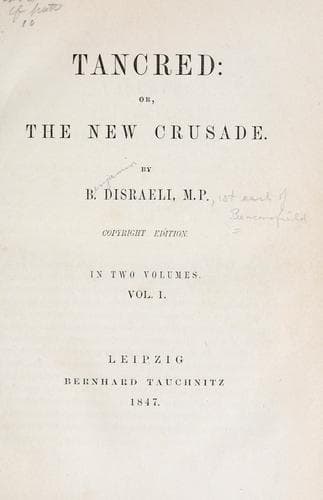
Tancred; Or, The New CrusadeDisraeli, Benjamin, Earl of Beaconsfield
ReligionJewish
Tancred; Or, The New Crusade
Disraeli, Benjamin, Earl of Beaconsfield
Christianity and other religions -- Judaism -- Fiction; Judaism -- Relations -- Christianity -- Fiction
It is to be noted, although the Omnipotent Creator might have found, had
it pleased him, in the humblest of his creations, an efficient agent
for his purpose, however difficult and sublime, that Divine Majesty has
never thought fit to communicate except with human beings of the very
highest powers. They are always men who have manifested an extraordinary
aptitude for great affairs, and the possession of a fervent and
commanding genius. They are great legislators, or great warriors, or
great poets, or orators of the most vehement and impassioned spirit.
Such were Moses, Joshua, the heroic youth of Hebron, and his magnificent
son; such, too, was Isaiah, a man, humanly speaking, not inferior to
Demosthenes, and struggling for a similar and as beautiful a cause,
the independence of a small state, eminent for its intellectual power,
against the barbarian grandeur of a military empire. All the great
things have been done by the little nations. It is the Jordan and the
Ilyssus that have civilised the modern races. An Arabian tribe, a clan
of the Ægean, have been the promulgators of all our knowledge; and
we should never have heard of the Pharaohs, of Babylon the great and
Nineveh the superb, of Cyrus and of Xerxes, had not it been for Athens
and Jerusalem.
Tancred rose with the sun from his encampment at Hebron, to traverse,
probably, the same route pursued by the spies when they entered the
Land of Promise. The transition from Canaan to the stony Arabia is
not abrupt. A range of hills separates Palestine from a high but level
country similar to the Syrian desert, sandy in some places, but covered
in all with grass and shrubs; a vast expanse of downs. Gradually the
herbage disappears, and the shrubs are only found tufting the ridgy tops
of low undulating sandhills. Soon the sand becomes stony, and no trace
of vegetation is ever visible excepting occasionally some thorny plant.
Then comes a land which alternates between plains of sand and dull
ranges of monotonous hills covered with loose flints; sometimes the
pilgrim winds his way through their dull ravines, sometimes he mounts
the heights and beholds a prospect of interminable desolation.
For three nights had Tancred encamped in this wilderness, halting at
some spot where they could find some desert shrubs that might serve as
food for the camels and fuel for themselves. His tent was soon pitched,
the night fires soon crackling, and himself seated at one with the
Sheikh and Baroni, he beheld with interest and amusement the picturesque
and flashing groups around him. Their fare was scant and simple: bread
baked upon the spot, the dried tongue of a gazelle, the coffee of the
neighbouring Mocha, and the pipe that ever consoles, if indeed the
traveller, whatever his hardships, could need any sustenance but his own
high thoughts in such a scene, canopied, too, by the most beautiful sky
and the most delicious climate in the world.
Public-domain text, read in full here on John Shaqi.
Reviews
Reviews
No reviews yet
Be the first to share your thoughts on this work.
Elsewhere in the archive
Join the Discussion
Join the discussion
Sign in to leave a comment or review.
Sign InorCreate an account