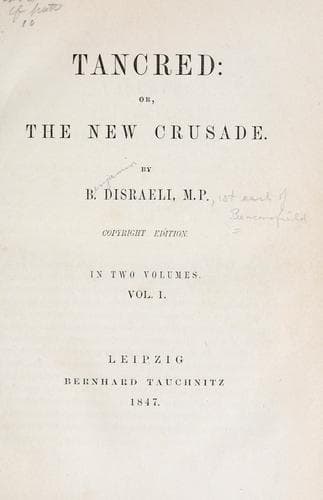
Tancred; Or, The New CrusadeDisraeli, Benjamin, Earl of Beaconsfield
ReligionJewish
Tancred; Or, The New Crusade
Disraeli, Benjamin, Earl of Beaconsfield
Christianity and other religions -- Judaism -- Fiction; Judaism -- Relations -- Christianity -- Fiction
Tancred re-entered his tent, and, reclining, fell into a reverie of
distracting thoughts. The history of his life and mind seemed with a
whirling power to pass before him; his birth, in clime unknown to the
Patriarchs; his education, unconsciously to himself, in an Arabian
literature; his imbibing, from his tender infancy, oriental ideas and
oriental creeds; the contrast that the occidental society in which he
had been reared presented to them; his dissatisfaction with that social
system; his conviction of the growing melancholy of enlightened Europe,
veiled, as it may be, with sometimes a conceited bustle, sometimes a
desperate shipwreck gaiety, sometimes with all the exciting empiricism
of science; his perplexity that, between the Asian revelation and the
European practice there should be so little conformity, and why the
relations between them should be so limited and imperfect; above all,
his passionate desire to penetrate the mystery of the elder world, and
share its celestial privileges and divine prerogative. Tancred sighed.
He looked round; some one had gently drawn his hand. It was the young
Emir kneeling, his beautiful blue eyes bedewed with tears.
‘You are unhappy, said Fakredeen, in a tone of plaintiveness.
‘It is the doom of man,’ replied Tancred; ‘and in my position sadness
should not seem strange.’
‘The curse of ten thousand mothers on those who made you a prisoner; the
curse of twenty thousand mothers on him who inflicted on you a wound!’
‘’Tis the fortune of life,’ said Tancred, more cheerfully; ‘and in truth
I was perhaps thinking of other things.’
‘Do you know why I trouble you when your heart is dark?’ said the young
Emir. ‘See now, if you will it, you are free. The great Sheikh has
consented that you should go to Sinai. I have two dromedaries here,
fleeter than the Kamsin. At the well of Mokatteb, where we encamp for
the night, I will serve raki to the Bedouins; I have some with me,
strong enough to melt the snow of Lebanon; if it will not do, they shall
smoke some timbak, that will make them sleep like pashas. I know this
desert as a man knows his father’s house; we shall be at Hebron before
they untie their eyelids. Tell me, is it good?’
‘Were I alone,’ said Tancred, ‘without a single guard, I must return.’
‘Why?’
‘Because I have pledged the word of a Christian noble.’
‘To a man who does not believe in Christ. Faugh! Is it not itself a sin
to keep faith with heretics?’
‘But is he one?’ said Tancred. ‘He believes in Moses; he disbelieves in
none of the seed of Abraham. He is of that seed himself! Would I were
such a heretic as Sheikh Amalek!’
‘If you will only pay me a visit in the Lebanon, I would introduce you
to our patriarch, and he would talk as much theology with you as you
like. For my own part it is not a kind of knowledge that I have much
cultivated; you know I am peculiarly situated, we have so many religions
on the mountain; but time presses; tell me, my prince, shall Hebron be
our point?’
Public-domain text, read in full here on John Shaqi.
Reviews
Reviews
No reviews yet
Be the first to share your thoughts on this work.
Elsewhere in the archive
Join the Discussion
Join the discussion
Sign in to leave a comment or review.
Sign InorCreate an account