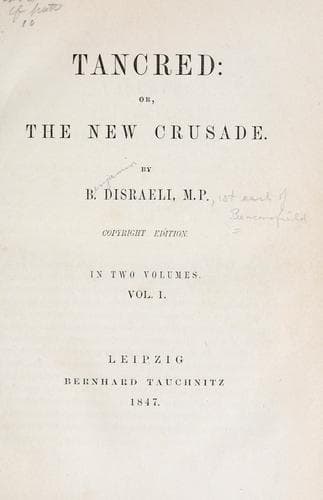
Tancred; Or, The New CrusadeDisraeli, Benjamin, Earl of Beaconsfield
ReligionJewish
Tancred; Or, The New Crusade
Disraeli, Benjamin, Earl of Beaconsfield
Christianity and other religions -- Judaism -- Fiction; Judaism -- Relations -- Christianity -- Fiction
‘Yet again, and Europe is in the throes of a great birth. The multitudes
again are brooding; but they are not now in the forest; they are in the
cities and in the fertile plains. Since the first sun of this century
rose, the intellectual colony of Arabia, once called Christendom,
has been in a state of partial and blind revolt. Discontented, they
attributed their suffering to the principles to which they owed
all their happiness, and in receding from which they had become
proportionately miserable. They have hankered after other gods than the
God of Sinai and of Calvary, and they have achieved only desolation.
Now they despair. But the eternal principles that controlled barbarian
vigour can alone cope with morbid civilisation. The equality of man
can only be accomplished by the sovereignty of God. The longing for
fraternity can never be satisfied but under the sway of a common father.
The relations between Jehovah and his creatures can be neither too
numerous nor too near. In the increased distance between God and man
have grown up all those developments that have made life mournful.
Cease, then, to seek in a vain philosophy the solution of the social
problem that perplexes you. Announce the sublime and solacing doctrine
of theocratic equality. Fear not, faint not, falter not. Obey the
impulse of thine own spirit, and find a ready instrument in every human
being.’
A sound, as of thunder, roused Tancred from his trance. He looked around
and above. There rose the mountains sharp and black in the clear purple
air; there shone, with undimmed lustre, the Arabian stars; but the voice
of the angel still lingered in his ear. He descended the mountain: at
its base, near the convent, were his slumbering guards, some steeds, and
crouching camels.
CHAPTER XXXVII.
_Fakredeen is Curious_
THE beautiful daughter of Besso, pensive and abstracted, played with her
beads in the pavilion of her grandfather. Two of her maidens, who had
attended her, in a corner of this inner compartment, accompanied the
wild murmur of their voices on a stringed instrument, which might in the
old days have been a psaltery. They sang the loves of Antar and of Ibla,
of Leila and of Mejnoun; the romance of the desert, tales of passion and
of plunder, of the rescue of women and the capture of camels, of heroes
with a lion heart, and heroines brighter and softer than the moon.
The beautiful daughter of Besso, pensive and abstracted, played with her
beads in the pavilion of her grandfather. Why is the beautiful daughter
of Besso pensive and abstracted? What thoughts are flitting over her
mind, silent and soft, like the shadows of birds over the sunshiny
earth?
Public-domain text, read in full here on John Shaqi.
Reviews
Reviews
No reviews yet
Be the first to share your thoughts on this work.
Elsewhere in the archive
Join the Discussion
Join the discussion
Sign in to leave a comment or review.
Sign InorCreate an account