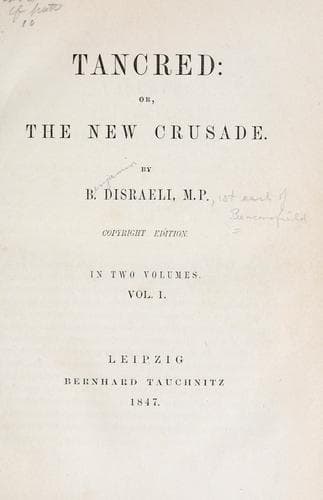
Tancred; Or, The New CrusadeDisraeli, Benjamin, Earl of Beaconsfield
ReligionJewish
Tancred; Or, The New Crusade
Disraeli, Benjamin, Earl of Beaconsfield
Christianity and other religions -- Judaism -- Fiction; Judaism -- Relations -- Christianity -- Fiction
After a little while, the poet ceased. Then there was a general hum and
great praise, and many men said to each other, ‘All this is true, for my
father told it to me before.’ The great Sheikh, who was highly pleased,
ordered his slaves to give the poet a cup of coffee, and, taking from
his own vest an immense purse, more than a foot in length, he extracted
from it, after a vast deal of research, one of the smallest
of conceivable coins, which the poet pressed to his lips, and,
notwithstanding the exiguity of the donation, declared that God was
great.
‘O Sheikh of Sheikhs,’ said the poet, ‘what I have recited, though it is
by the gift of God, is in fact written, and has been ever since the days
of the giants; but I have also dipped my pen into my own brain, and
now I would recite a poem which I hope some day may be suspended in the
temple of Mecca. It is in honour of one who, were she to rise to our
sight, would be as the full moon when it rises over the desert. Yes, I
sing of Eva, the daughter of Amalek (the Bedouins always omitted Besso
in her genealogy), Eva, the daughter of a thousand chiefs. May she never
quit the tents of her race! May she always ride upon Nejid steeds and
dromedaries, with harness of silver! May she live among us for ever! May
she show herself to the people like a free Arabian maiden!’
‘They are the thoughts of truth,’ said the delighted Bedouins to one
another; ‘every word is a pearl.’
And the great Sheikh sent a slave to express his Wish that Eva and her
maidens should appear. So she came to listen to the ode which the poet
had composed in her honour. He had seen palm trees, but they were not as
tall and graceful as Eva; he had beheld the eyes of doves and antelopes,
but they were not as bright and soft as hers; he had tasted the fresh
springs in the wilderness, but they were not more welcome than she; and
the soft splendour of the desert moon was not equal to her brow. She
was the daughter of Amalek, the daughter of a thousand chiefs. Might
she live for ever in their tents; ever ride on Nejid steeds and on
dromedaries with silver harness; ever show herself to the people like a
free Arabian maiden!
The poet, after many variations on this theme, ceased amid great
plaudits.
‘He is a true poet,’ said an Arab, who was, like most of his brethren, a
critic; ‘he is in truth a second Antar.’
‘If he had recited these verses before the King of Persia, he would have
given him a thousand camels,’ replied his neighbour, gravely.
‘They ought to be suspended in the temple of Mecca,’ said a third.
‘What I most admire is his image of the full moon; that cannot be-too
often introduced,’ said a fourth.
‘Truly the moon should ever shine,’ said a fifth. ‘Also in all truly
fine verses there should be palm trees and fresh springs.’
Public-domain text, read in full here on John Shaqi.
Reviews
Reviews
No reviews yet
Be the first to share your thoughts on this work.
Elsewhere in the archive
Join the Discussion
Join the discussion
Sign in to leave a comment or review.
Sign InorCreate an account