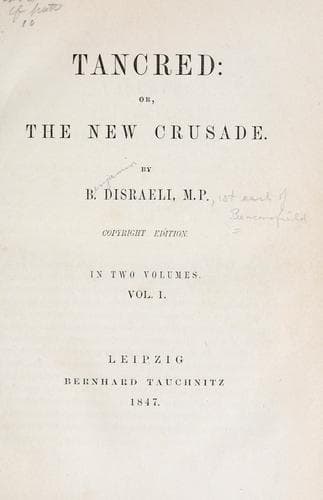
Tancred; Or, The New CrusadeDisraeli, Benjamin, Earl of Beaconsfield
ReligionJewish
Tancred; Or, The New Crusade
Disraeli, Benjamin, Earl of Beaconsfield
Christianity and other religions -- Judaism -- Fiction; Judaism -- Relations -- Christianity -- Fiction
There were none of the usual means and materials of illusion at hand;
neither space, nor distance, nor cunning lights; it was a confined
tavern room with some glaring tapers, and Sidonia himself was almost
within arm’s reach of the performers. Yet a representation more
complete, more finely conceived, and more perfectly executed, he had
never witnessed. It was impossible to credit that these marble forms,
impressed with ideal grace, so still, so sad, so sacred, could be the
little tumblers, who, but half-an-hour before, were disporting on the
coarse boards at his side.
The father always described, before the curtain was withdrawn, with a
sort of savage terseness, the subject of the impending scene. The groups
did not continue long; a pause of half a minute, and the circular stage
revolved, and the curtain again closed. This rapidity of representation
was necessary, lest delay should compromise the indispensable
immovable-ness of the performers.
‘Now,’ said Baroni, turning his head to the audience, and slightly
touching his violin, ‘Christ falls under the weight of the cross.’
And immediately the curtain parted, and Sidonia beheld a group in the
highest style of art, and which though deprived of all the magic of
colour, almost expressed the passion of Correggio.
‘It is Alfred,’ said Baroni, as Sidonia evinced his admiration. ‘He
chiefly arranges all this, under my instructions. In drapery his talent
is remarkable.’
At length, after a series of representations, which were all worthy of
being exhibited in the pavilions of princes, Baroni announced the last
scene.
‘What you are going to see now is the Descent from the Cross; it is
after Rubens, one of the greatest masters that ever lived, if you
ever heard of such a person,’ he added, in a grumbling voice, and then
turning to Sidonia, he said, ‘This crucifixion is the only thing which
these savages seem at all to understand; but I should like you, sir,
as you are an artist, to see the children in some Greek or Roman story:
Pygmalion, or the Death of Agrippina. I think you would be pleased.’
‘I cannot be more pleased than I am now,’ said Sidonia. ‘I am also
astonished.’
But here Baroni was obliged to scrape his fiddle, for the curtain moved.
‘It is a triumph of art,’ said Sidonia, as he beheld the immortal group
of Rubens reproduced with a precision and an exquisite feeling which no
language can sufficiently convey, or too much extol.
The performances were over, the little artists were summoned to the
front scene to be applauded, the scanty audience were dispersing:
Sidonia lingered.
‘You are living in this house, I suppose?’ he said to Baroni.
Baroni shook his head. ‘I can afford no roof except my own.’
‘And where is that?’
Public-domain text, read in full here on John Shaqi.
Reviews
Reviews
No reviews yet
Be the first to share your thoughts on this work.
Elsewhere in the archive
Join the Discussion
Join the discussion
Sign in to leave a comment or review.
Sign InorCreate an account