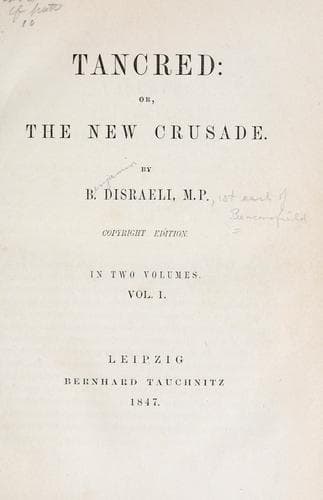
Tancred; Or, The New CrusadeDisraeli, Benjamin, Earl of Beaconsfield
ReligionJewish
Tancred; Or, The New Crusade
Disraeli, Benjamin, Earl of Beaconsfield
Christianity and other religions -- Judaism -- Fiction; Judaism -- Relations -- Christianity -- Fiction
There are regions more lofty than the glaciered crests of Lebanon;
mountain scenery more sublime, perhaps even more beautiful: its peaks
are not lost in the clouds like the mysterious Ararat; its forests
are not as vast and strange as the towering Himalaya; it has not the
volcanic splendour of the glowing Andes; in lake and in cataract it
must yield to the European Alps; but for life, vigorous, varied, and
picturesque, there is no highland territory in the globe that can for a
moment compare with the great chain of Syria.
Man has fled from the rich and servile plains, from the tyranny of the
Turk and from Arabian rapine, to clothe the crag with vines, and rest
under his fig tree on the mountain top. An ingenious spirit, unwearied
industry, and a bland atmosphere have made a perpetual garden of the
Syrian mountains. Their acclivities sparkle with terraces of corn and
fruit. Castle and convent crown their nobler heights, and flat-roofed
villages nestle amid groves of mulberry trees. Among these mountains
we find several human races, several forms of government, and
several schemes of religion, yet everywhere liberty: a proud, feudal
aristocracy; a conventual establishment, which in its ramifications
recalls the middle ages; a free and armed peasantry, whatever their
creed, Emirs on Arabian steeds, bishops worthy of the Apostles, the
Maronite monk, the horned head-gear of the Druses.
Some of those beautiful horses, for which Fakredeen was celebrated, had
awaited the travellers at Beiroot. The journey through the mountain was
to last three days before they reached Canobia. They halted one night at
a mountain village, where the young Emir was received with enthusiastic
devotion, and on the next at a small castle belonging to Fakredeen, and
where resided one of his kinsmen. Two hours before sunset, on the third
day, they were entering the oak forest to which we referred, and through
whose glades they journeyed for about half an hour. On arriving at the
convent-crowned height opposite, they beheld an expanse of country; a
small plain amid the mountains; in many parts richly cultivated,
studded by several hamlets, and watered by a stream, winding amid rich
shrubberies of oleander.
Almost in the middle of this plain, on a height superior to the
immediate elevations which bounded it, rose a mountain of gradual
ascent, covered with sycamores, and crowned by a superb Saracenic
castle.
‘Canobia!’ said Fakredeen to Tancred, ‘which I hope you never will
quit.’
‘It would be difficult,’ rejoined Tancred, animated. ‘I have seldom seen
a sight more striking and more beautiful.’
In the meantime, Freeman and Trueman, who were far in the rear amid
Fakredeen’s attendants, exchanged congratulating glances of blended
surprise and approbation.
‘This is the first gentleman’s seat I have seen since we left England,’
said Freeman.
‘There must have been a fine coming of age here,’ rejoined Trueman.
Public-domain text, read in full here on John Shaqi.
Reviews
Reviews
No reviews yet
Be the first to share your thoughts on this work.
Elsewhere in the archive
Join the Discussion
Join the discussion
Sign in to leave a comment or review.
Sign InorCreate an account