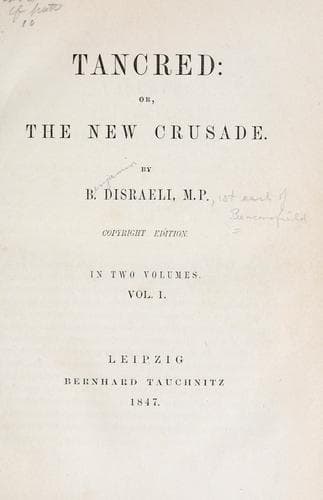
Tancred; Or, The New CrusadeDisraeli, Benjamin, Earl of Beaconsfield
ReligionJewish
Tancred; Or, The New Crusade
Disraeli, Benjamin, Earl of Beaconsfield
Christianity and other religions -- Judaism -- Fiction; Judaism -- Relations -- Christianity -- Fiction
As we must not compare Tancred and Fakredeen to Damon and Pythias,
and as we cannot easily find in Pall Mall or Park Lane a parallel more
modish, we must be content to say, that youth, sympathy, and occasion
combined to create between them that intimacy which each was prompt to
recognise as one of the principal sources of his happiness, and which
the young Emir, at any rate, was persuaded must be as lasting as it was
fervent and profound.
Fakredeen was seen to great advantage among his mountains. He was an
object of universal regard, and, anxious to maintain the repute of which
he was proud, and which was to be the basis of his future power,
it seemed that he was always in a gracious and engaging position.
Brilliant, sumptuous, and hospitable, always doing something kind, or
saying something that pleased, the Emirs and Sheikhs, both Maronite and
Druse, were proud of the princely scion of their greatest house, and
hastened to repair to Ca-nobia, where they were welcome to ride any of
his two hundred steeds, feast on his flocks, quaff his golden wine of
Lebanon, or smoke the delicate tobaccos of his celebrated slopes.
As for Tancred, his life was novel, interesting, and exciting. The
mountain breezes soon restored his habitual health; his wound entirely
healed; each day brought new scenes, new objects, new characters; and
there was ever at his side a captivating companion, who lent additional
interest to all he saw and heard by perpetually dwelling on the great
drama which they were preparing, and in which all these personages and
circumstances were to perform their part and advance their purpose.
At this moment Fakredeen proposed to himself two objects: the first was,
to bring together the principal chiefs of the mountain, both Maronite
and Druse, and virtually to carry into effect at Ca-nobia that
reconciliation between the two races which had been formally effected at
Beiroot, in the preceding month of June, by the diplomatic interference
of the Great Powers, and through the signature of certain articles of
peace to which we have alluded. His second object was to increase his
already considerable influence with these personages, by exhibiting
to them, as his guest and familiar friend, an English prince, whose
presence could only be accounted for by duties too grave for ordinary
envoys, and who was understood to represent, in their fullest sense, the
wealth and authority of the richest and most potent of nations.
Public-domain text, read in full here on John Shaqi.
Reviews
Reviews
No reviews yet
Be the first to share your thoughts on this work.
Elsewhere in the archive
Join the Discussion
Join the discussion
Sign in to leave a comment or review.
Sign InorCreate an account