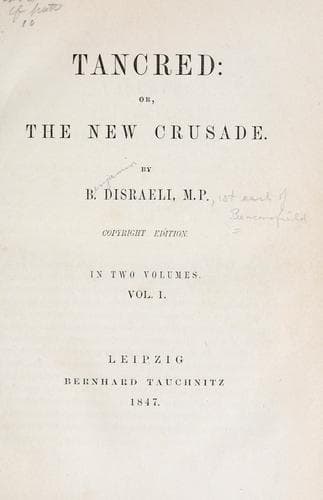
Tancred; Or, The New CrusadeDisraeli, Benjamin, Earl of Beaconsfield
ReligionJewish
Tancred; Or, The New Crusade
Disraeli, Benjamin, Earl of Beaconsfield
Christianity and other religions -- Judaism -- Fiction; Judaism -- Relations -- Christianity -- Fiction
Always conspicuous among the great families of the Lebanon, during
the last century and a half preeminent, has been the House of Shehaab,
possessing entirely one of the provinces, and widely disseminated and
powerfully endowed in several of the others. Since the commencement of
the eighteenth century, the virtual sovereignty of the country has been
exercised by a prince of this family, under the title of Chief Emir. The
chiefs of all the different races have kissed the hand of a Shehaab; he
had the power of life and death, could proclaim war and confer honours.
Of all this family, none were so supreme as the Emir Bescheer, who
governed Lebanon during the Egyptian invasion, and to whose subdolous
career and its consequences we have already referred. When the Turks
triumphed in 1840, the Emir Bescheer was deposed, and with his sons sent
prisoner to Constantinople. The Porte, warned at that time by the too
easy invasion of Syria and the imminent peril which it had escaped,
wished itself to assume the government of Lebanon, and to garrison the
passes with its troops; but the Christian Powers would not consent to
this proposition, and therefore Kassim Shehaab was called to the Chief
Emirate. Acted upon by the patriarch of the Maronites, Kassim, who was a
Christian Shehaab, countenanced the attempts of his holiness to destroy
the feudal privileges of the Druse mookatadgis, while those of the
Maronites were to be retained. This produced the civil war of 1841
in Lebanon, which so perplexed and scandalised England, and which
was triumphantly appealed to by France as indubitable evidence of the
weakness and unpopularity of the Turks, and the fruitlessness of our
previous interference. The Turks had as little to do with it as M.
Guizot or Lord Palmerston; but so limited is our knowledge upon these
subjects that the cry was successful, and many who had warmly supported
the English minister during the previous year, and probably in equal
ignorance of the real merits of the question, began now to shake their
heads and fear that we had perhaps been too precipitate.
The Porte adroitly took advantage of the general anarchy to enforce
the expediency of its original proposition, to which the Great Powers,
however, would not assent. Kassim was deposed, after a reign of a few
months, amid burning villages and their slaughtered inhabitants; and, as
the Porte was resolved not to try another Shehaab, and the Great Powers
were resolved not to trust the Porte, diplomacy was obliged again to
interfere, and undertake to provide Lebanon with a government.
Public-domain text, read in full here on John Shaqi.
Reviews
Reviews
No reviews yet
Be the first to share your thoughts on this work.
Elsewhere in the archive
Join the Discussion
Join the discussion
Sign in to leave a comment or review.
Sign InorCreate an account