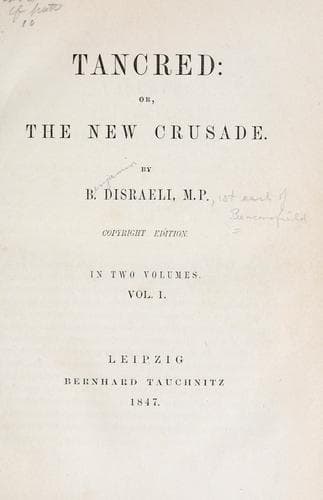
Tancred; Or, The New CrusadeDisraeli, Benjamin, Earl of Beaconsfield
ReligionJewish
Tancred; Or, The New Crusade
Disraeli, Benjamin, Earl of Beaconsfield
Christianity and other religions -- Judaism -- Fiction; Judaism -- Relations -- Christianity -- Fiction
Came slowly, on steeds dark as night, up the winding steep of Canobia,
with a company of twenty men on foot armed with muskets and handjars,
the two ferocious brothers Abuneked, Nasif and Hamood. Pale is the cheek
of the daughters of Maron at the fell name of Abuneked. The Abunekeds
were the Druse lords of the town of Deir el Kamar, where the majority of
the inhabitants were Christian. When the patriarch tried to deprive the
Druses of their feudal rights, the Abunekeds attacked and sacked their
own town of Deir el Kamar. The civil war being terminated, and it being
agreed, in the settlement of the indemnities from the Druses to the
Maronites, that all plunder still in possession of the plunderers should
be restored, Nasif Abuneked said, ‘I have five hundred silver horns, and
each of them I took from the head of a Christian woman. Come and fetch
them.’
But all this is forgotten now; and least of all should it be remembered
by the meek-looking individual who is at this moment about to ascend
the winding steep of Canobia. Riding on a mule, clad in a coarse brown
woollen dress, in Italy or Spain we should esteem him a simple Capuchin,
but in truth he is a prelate, and a prelate of great power; Bishop
Nicodemus, to wit, prime councillor of the patriarch, and chief prompter
of those measures that occasioned the civil war of 1841. A single
sacristan walks behind him, his only retinue, and befitting his limited
resources; but the Maronite prelate is recompensed by universal respect;
his vanity is perpetually gratified, and, when he appears, Sheikh and
peasant are alike proud to kiss the hand which his reverence is ever
prompt to extend.
Placed on a more eminent stage, and called upon to control larger
circumstances, Bishop Nicodemus might have rivalled the Bishop of Autun;
so fertile was he in resource, and so intuitive was his knowledge of
men. As it was, he wasted his genius in mountain squabbles, and in
regulating the discipline of his little church; suspending priests,
interdicting monks, and inflicting public penance on the laity. He
rather resembled De Retz than Talleyrand, for he was naturally turbulent
and intriguing. He could under no circumstances let well alone. He was
a thorough Syrian, at once subtle and imaginative. Attached to the House
of Shehaab by policy, he was devoted to Fakredeen as much by sympathy
as interest, and had contrived the secret mission of Archbishop Murad
to Europe, which had so much perplexed M. Guizot, Lord Cowley, and Lord
Aberdeen; and which finally, by the intervention of the same Bishop
Nicodemus, Fakredeen had disowned.
Public-domain text, read in full here on John Shaqi.
Reviews
Reviews
No reviews yet
Be the first to share your thoughts on this work.
Elsewhere in the archive
Join the Discussion
Join the discussion
Sign in to leave a comment or review.
Sign InorCreate an account