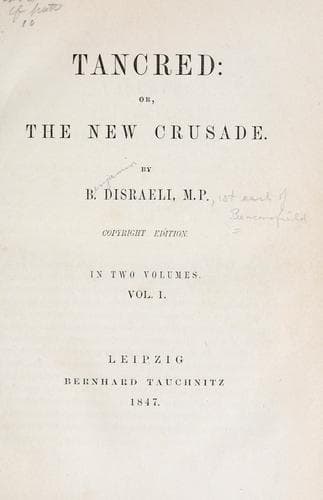
Tancred; Or, The New CrusadeDisraeli, Benjamin, Earl of Beaconsfield
ReligionJewish
Tancred; Or, The New Crusade
Disraeli, Benjamin, Earl of Beaconsfield
Christianity and other religions -- Judaism -- Fiction; Judaism -- Relations -- Christianity -- Fiction
The hunting party was to last three days, and few intended to leave
Canobia on the morrow; but it must not be supposed that the guests
experienced any very unusual hardships in what the reader may consider a
far from satisfactory mode of passing their night. To say nothing of the
warm and benignant climate, the Easterns have not the custom of retiring
or rising with the formality of the Occidental nations. They take their
sleep when they require it, and meet its embrace without preparation.
One cause of this difference undoubtedly is, that the Orientals do not
connect the business of the toilet with that of rest. The daily bath,
with its elaborate processes, is the spot where the mind ponders on the
colour of a robe or the fashion of a turban; the daily bath, which is
the principal incident of Oriental habits, and which can scarcely be
said to exist among our own.
Fakredeen had yielded even his own chambers to his friends. Every divan
in Canobia was open, excepting the rooms of Tancred. These were sacred,
and the Emir had requested his friend to receive him as a guest during
the festival, and apportion him one of his chambers. The head of the
House of Talhook was asleep with the tube of his nargileh in his mouth;
the Yezbek had unwound his turban, cast off his sandals, wrapped himself
in his pelisses, and fairly turned in; Bishop Nicodemus was kneeling
in a corner and kissing a silver cross; and Hamood Abu-neked had rolled
himself up in a carpet, and was snoring as if he were blowing through
one of the horns of the Maronites. Fakredeen shot a glance at Tancred,
instantly recognised. Then, rising and giving the salaam of peace to
his guests, the Emir and his English friend made their escape down a
corridor, at the bottom of which was one of the few doors that could be
found in the castle of Canobia. Baroni received them, on the watch
lest some cruising Sheikh should appropriate their resting-place. The
young-moon, almost as young and bright as it was two months before at
Gaza, suffused with lustre the beautiful garden of fruit and flowers
without. Under the balcony, Baroni had placed a divan with many
cushions, a lamp with burning coffee, and some fresh nargilehs.
‘Thank God, we are alone!’ exclaimed Fakredeen. ‘Tell me, my Tancred,
what do you think of it all?’
CHAPTER XLIV.
_Fakredeen’s Debts_
IT HAS been a great day,’ said Tancred ‘not to be forgotten.’
‘Yes; but what do you think of them? Are they the fellows I described;
the men that might conquer the world?’
‘To conquer the world depends on men not only being good soldiers, but
being animated by some sovereign principle that nothing can resist,’
replied Tancred.
‘But that we have got,’ rejoined Fakredeen.
‘But have they got it?’
‘We can give it to them.’
‘I am not so sure of that. It seems to me that we are going to establish
a theocratic equality by the aid of the feudal system.’
Public-domain text, read in full here on John Shaqi.
Reviews
Reviews
No reviews yet
Be the first to share your thoughts on this work.
Elsewhere in the archive
Join the Discussion
Join the discussion
Sign in to leave a comment or review.
Sign InorCreate an account