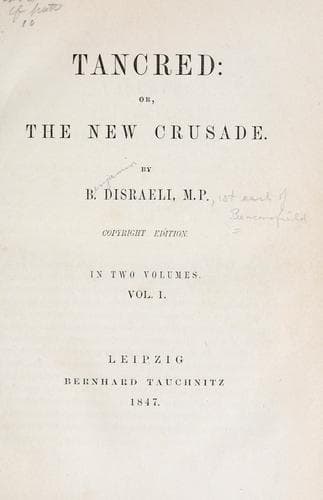
Tancred; Or, The New CrusadeDisraeli, Benjamin, Earl of Beaconsfield
ReligionJewish
Tancred; Or, The New Crusade
Disraeli, Benjamin, Earl of Beaconsfield
Christianity and other religions -- Judaism -- Fiction; Judaism -- Relations -- Christianity -- Fiction
That the proud soul of Tancred of Montacute, with its sublime
aspirations, its inexorable purpose, its empyrean ambition, should find
a votary in one apparently so whimsical, so worldly, and so worthless,
may at the first glance seem improbable; yet a nearer and finer
examination may induce us to recognise its likelihood. Fakredeen had
a brilliant imagination and a passionate sensibility; his heart was
controlled by his taste, and, when that was pleased and satisfied, he
was capable of profound feeling and of earnest conduct. Moral worth
had no abstract charms for him, and he could sympathise with a dazzling
reprobate; but virtue in an heroic form, lofty principle, and sovereign
duty invested with all the attributes calculated to captivate his rapid
and refined perception, exercised over him a resistless and transcendent
spell. The deep and disciplined intelligence of Tancred, trained in all
the philosophy and cultured with all the knowledge of the West, acted
with magnetic power upon a consciousness the bright vivacity of which
was only equalled by its virgin ignorance of all that books can teach,
and of those great conclusions which the studious hour can alone
elaborate. Fakredeen hung upon his accents like a bee, while Tancred
poured forth, without an effort, the treasures of his stored memory and
long musing mind. He went on, quite unconscious that his companion was
devoid of that previous knowledge, which, with all other persons, would
have been a preliminary qualification for a profitable comprehension of
what he said. Fakredeen gave him no hint of this: the young Emir trusted
to his quick perception to sustain him, although his literary training
was confined to an Arabic grammar, some sentences of wise men, some
volumes of poetry, and mainly and most profitably to the clever Courier
de Smyrne, and occasionally a packet of French journals which he
obtained from a Levantine consul.
It was therefore with a feeling not less than enthusiastic that
Fakredeen responded to the suggestive influence of Tancred. The want
that he had long suffered from was supplied, and the character he had
long mused over had appeared. Here was a vast theory to be reduced to
practice, and a commanding mind to give the leading impulse. However
imperfect may have been his general conception of the ideas of Tancred,
he clearly comprehended that their fulfilment involved his two great
objects, change and action. Compared with these attainments on a great
scale, his present acquisition and position sank into nothingness. A
futurity consisting of a Syrian Emirate and a mountain castle figured as
intolerable, and Fakredeen, hoping all things and prepared for anything,
flung to the winds all consideration for his existing ties, whether in
the shape of domains or of debts.
Public-domain text, read in full here on John Shaqi.
Reviews
Reviews
No reviews yet
Be the first to share your thoughts on this work.
Elsewhere in the archive
Join the Discussion
Join the discussion
Sign in to leave a comment or review.
Sign InorCreate an account