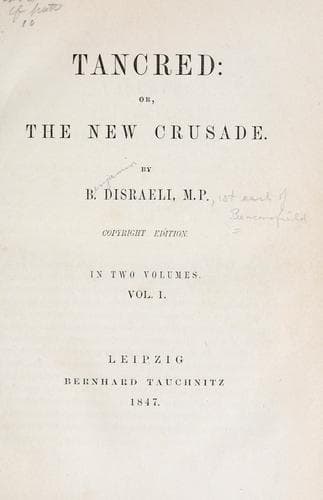
Tancred; Or, The New CrusadeDisraeli, Benjamin, Earl of Beaconsfield
ReligionJewish
Tancred; Or, The New Crusade
Disraeli, Benjamin, Earl of Beaconsfield
Christianity and other religions -- Judaism -- Fiction; Judaism -- Relations -- Christianity -- Fiction
‘It is strange,’ said Fakredeen, ‘but frequently as I have been at
Aleppo and Antioch, I have never been in their country. I have always
been warned against it, always kept from it, which indeed ought to have
prompted my earliest efforts, when I was my own master, to make them
a visit. But, I know not how it is, there are some prejudices that do
stick to one. I have a prejudice against the Ansarey, a sort of fear, a
kind of horror. ‘Tis vastly absurd. I suppose my nurse instilled it into
me, and frightened me with them when I would not sleep. Besides, I had
an idea that they particularly hated the Shehaabs. I recollect so well
the Emir Bescheer, at Bteddeen, bestowing endless imprecations on them.’
‘He made many efforts to win them, though,’ said Sheikh Hamood, ‘and so
did the Emir Yousef.’
‘And you think without them, noble Sheikh,’ said Tancred, ‘that Syria is
not secure?’
‘I think, with them and peace with the desert, that Syria might defy
Turk and Egyptian.’
‘And carry the war into the enemy’s quarters, if necessary?’ said
Fakredeen.
‘If they would let us alone, I am content to leave them,’ said Hamood.
‘Hem!’ said the Emir Fakredeen. ‘Do you see that gazelle, noble Sheikh?
How she bounds along! What if we follow her, and the pursuit should lead
us into the lands of the Ansarey?’
‘It would be a long ride,’ said Sheikh Hamood. ‘Nor should I care much
to trust my head in a country governed by a woman.’
‘A woman!’ exclaimed Tancred and Fakredeen.
‘They say as much,’ said Sheikh Hamood; ‘perhaps it is only a
coffee-house tale.’
‘I never heard it before,’ said Fakredeen. ‘In the time of my uncle,
Elderidis was Sheikh. I have heard indeed that the Ansarey worship a
woman.’
‘Then they would be Christians,’ said Sheikh Hamood, ‘and I never heard
that.’
CHAPTER XLVI.
_The Laurellas_
IT WAS destined that Napoleon should never enter Rome, and Mahomet never
enter Damascus. What was the reason of this? They were not uninterested
in those cities that interest all. The Emperor selected from the capital
of the Cæsars the title of his son; the Prophet, when he beheld the
crown of Syria, exclaimed that it was too delightful, and that he must
reserve his paradise for another world. Buonaparte was an Italian, and
must have often yearned after the days of Rome triumphant. The son of
Abdallah was descended from the patriarchs, whose progenitor had been
moulded out of the red clay of the most ancient city in the world.
Absorbed by the passionate pursuit of the hour, the two heroes postponed
a gratification which they knew how to appreciate, but which, with all
their success, all their power, and all their fame, they were never
permitted to indulge. What moral is to be drawn from this circumstance?
That we should never lose an occasion. Opportunity is more powerful even
than conquerors and prophets.
Public-domain text, read in full here on John Shaqi.
Reviews
Reviews
No reviews yet
Be the first to share your thoughts on this work.
Elsewhere in the archive
Join the Discussion
Join the discussion
Sign in to leave a comment or review.
Sign InorCreate an account