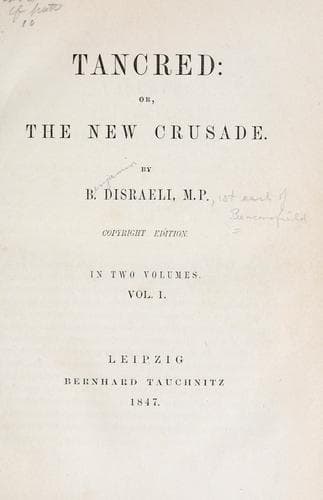
Tancred; Or, The New CrusadeDisraeli, Benjamin, Earl of Beaconsfield
ReligionJewish
Tancred; Or, The New Crusade
Disraeli, Benjamin, Earl of Beaconsfield
Christianity and other religions -- Judaism -- Fiction; Judaism -- Relations -- Christianity -- Fiction
At this moment the chamber was enlivened by the presence of many
individuals. Most of these were guests; one was the master of the
columns and the fountains; a man much above the middle height, though as
well proportioned as his sumptuous hall; admirably handsome, for beauty
and benevolence blended in the majestic countenance of Adam Besso.
To-day his Syrian robes were not unworthy of his palace; the cream-white
shawl that encircled his brow with its ample folds was so fine that the
merchant who brought it to him carried it over the ocean and the desert
in the hollow shell of a pomegranate. In his girdle rested a handjar,
the sheath of which was of a rare and vivid enamel, and the hilt
entirely of brilliants.
A slender man of middle size, who, as he stood by Besso, had a
diminutive appearance, was in earnest conversation with his host. This
personage was adorned with more than one order, and dressed in the Frank
uniform of one of the Great Powers, though his head was shaven, for
he wore a tarboush or red cap, although no turban. This gentleman was
Signor Elias de Laurella, a wealthy Hebrew merchant at Damascus, and
Austrian consul-general _ad honorem_; a great man, almost as celebrated
for his diplomatic as for his mercantile abilities; a gentleman who
understood the Eastern question; looked up to for that, but still more,
in that he was the father of the two prettiest girls in the Levant.
The Mesdemoiselles de Laurella, Thérèse and Sophonisbe, had just
completed their education, partly at Smyrna, the last year at
Marseilles. This had quite turned their heads; they had come back with a
contempt for Syria, the bitterness of which was only veiled by the high
style of European nonchalance, of which they had a supreme command, and
which is, perhaps, our only match for Eastern repose. The Mesdemoiselles
de Laurella were highly accomplished, could sing quite ravishingly,
paint fruits and flowers, and drop to each other, before surrounding
savages, mysterious allusions to feats in ballrooms, which, alas! no
longer could be achieved. They signified, and in some degree solaced,
their intense disgust at their present position by a haughty and
amusingly impassable demeanour, which meant to convey their superiority
to all surrounding circumstances. One of their favourite modes of
asserting this pre-eminence was wearing the Frank dress, which their
father only did officially, and which no female member of their family
had ever assumed, though Damascus swarmed with Laurellas. Nothing in the
dreams of Madame Carson, or Madame Camille, or Madame Devey, nothing in
the blazoned pages of the Almanachs des Dames and Belle Assemblée, ever
approached the Mdlles. Laurella, on a day of festival. It was the acme.
Nothing could be conceived beyond it; nobody could equal it. It was
taste exaggerated, if that be possible; fashion baffling pursuit, if
that be permitted. It was a union of the highest moral and material
Public-domain text, read in full here on John Shaqi.
Reviews
Reviews
No reviews yet
Be the first to share your thoughts on this work.
Elsewhere in the archive
Join the Discussion
Join the discussion
Sign in to leave a comment or review.
Sign InorCreate an account