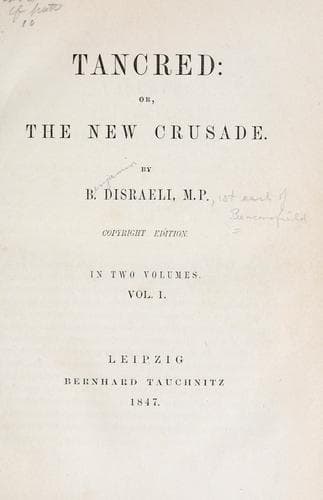
Tancred; Or, The New CrusadeDisraeli, Benjamin, Earl of Beaconsfield
ReligionJewish
Tancred; Or, The New Crusade
Disraeli, Benjamin, Earl of Beaconsfield
Christianity and other religions -- Judaism -- Fiction; Judaism -- Relations -- Christianity -- Fiction
Madame Laurella, the mother of these young ladies, would in Europe have
been still styled young. She was a Smyrniote, and had been a celebrated
beauty. The rose had since then too richly expanded, but even now, with
her dark eyelash charged with yamusk, her cheek touched with rouge, and
her fingers tipped with henna, her still fine hair exaggerated by art
or screened by her jewelled turban, she would have been a striking
personage, even if it had not been for the blaze of jewels with
which she was suffused and environed. The existence of this lady was
concentred in her precious gems. An extreme susceptibility on this head
is very prevalent among the ladies of the Levant, and the quantity
of jewels that they accumulate far exceeds the general belief. Madame
Laurella was without a rival in this respect, and resolved to maintain
her throne; diamonds alone did not satisfy her; immense emeralds, rubies
as big as pigeons’ eggs, prodigious ropes of pearls, were studded and
wound about every part of her rich robes. Every finger glittered,
and bracelets flashed beneath her hanging sleeves. She sat in silent
splendour on a divan, now and then proudly moving a fan of feathers,
lost in criticism of the jewels of her friends, and in contemplation of
her own.
A young man, tall and well-looking, dressed as an Oriental, but with an
affected, jerking air, more French than Syrian, moved jauntily about
the room, speaking to several persons for a short time, shrugging
his shoulders and uttering commonplaces as if they were poignant
originalities. This was Hillel Besso, the eldest son of the Besso of
Aleppo, and the intended husband of Eva. Hillel, too, had seen the
world, passed a season at Pera, where he had worn the Frank dress, and,
introduced into the circles by the lady of the Austrian Internuncio,
had found success and enjoyed himself. He had not, however, returned
to Syria with any of the disgust shared by the Mesdemoiselles Laurella.
Hillel was neither ashamed of his race nor his religion: on the
contrary, he was perfectly satisfied with this life, with the family
of Besso in general, and with himself particularly. Hillel was a little
philosophical, had read Voltaire, and, free from prejudices, conceived
himself capable of forming correct opinions. He listened smiling and in
silence to Eva asserting the splendour and superiority of their race,
and sighing for the restoration of their national glory, and then
would say, in a whisper to a friend, and with a glance of epigrammatic
airiness, ‘For my part, I am not so sure that we were ever better off
than we are.’
Public-domain text, read in full here on John Shaqi.
Reviews
Reviews
No reviews yet
Be the first to share your thoughts on this work.
Elsewhere in the archive
Join the Discussion
Join the discussion
Sign in to leave a comment or review.
Sign InorCreate an account