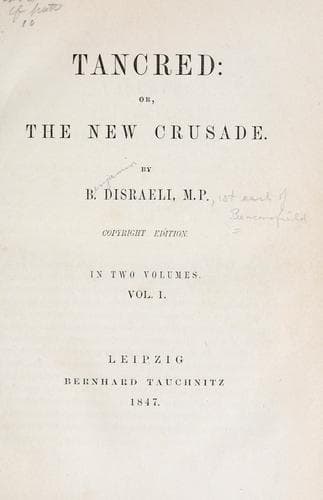
Tancred; Or, The New CrusadeDisraeli, Benjamin, Earl of Beaconsfield
ReligionJewish
Tancred; Or, The New Crusade
Disraeli, Benjamin, Earl of Beaconsfield
Christianity and other religions -- Judaism -- Fiction; Judaism -- Relations -- Christianity -- Fiction
Conceive a being born and bred in the Judenstrasse of Hamburg or
Frankfort, or rather in the purlieus of our Houndsditch or Minories,
born to hereditary insult, without any education, apparently without a
circumstance that can develop the slightest taste, or cherish the least
sentiment for the beautiful, living amid fogs and filth, never treated
with kindness, seldom with justice, occupied with the meanest, if
not the vilest, toil, bargaining for frippery, speculating in usury,
existing for ever under the concurrent influence of degrading causes
which would have worn out, long ago, any race that was not of the
unmixed blood of Caucasus, and did not adhere to the laws of Moses;
conceive such a being, an object to you of prejudice, dislike, disgust,
perhaps hatred. The season arrives, and the mind and heart of that being
are filled with images and passions that have been ranked in all ages
among the most beautiful and the most genial of human experience; filled
with a subject the most vivid, the most graceful, the most joyous, and
the most exuberant; a subject which has inspired poets, and which has
made gods; the harvest of the grape in the native regions of the Vine.
He rises in the morning, goes early to some White-chapel market,
purchases some willow boughs for which he has previously given
a commission, and which are brought, probably, from one of the
neighbouring rivers of Essex, hastens home, cleans out the yard of his
miserable tenement, builds his bower, decks it, even profusely, with the
finest flowers and fruits that he can procure, the myrtle and the citron
never forgotten, and hangs its roof with variegated lamps. After the
service of his synagogue, he sups late with his wife and his children in
the open air, as if he were in the pleasant villages of Galilee, beneath
its sweet and starry sky.
Perhaps, as he is giving the Keedush, the Hebrew blessing to the Hebrew
meal, breaking and distributing the bread, and sanctifying, with a
preliminary prayer, the goblet of wine he holds, the very ceremony which
the Divine Prince of Israel, nearly two thousand years ago, adopted
at the most memorable of all repasts, and eternally invested with
eucharistic grace; or, perhaps, as he is offering up the peculiar
thanksgiving of the Feast of Tabernacles, praising Jehovah for the
vintage which his children may no longer cull, but also for His promise
that they may some day again enjoy it, and his wife and his children are
joining in a pious Hosanna, that is, Save us! a party of Anglo-Saxons,
very respectable men, ten-pounders, a little elevated it may be, though
certainly not in honour of the vintage, pass the house, and words like
these are heard:
‘I say, Buggins, what’s that row?’
Public-domain text, read in full here on John Shaqi.
Reviews
Reviews
No reviews yet
Be the first to share your thoughts on this work.
Elsewhere in the archive
Join the Discussion
Join the discussion
Sign in to leave a comment or review.
Sign InorCreate an account