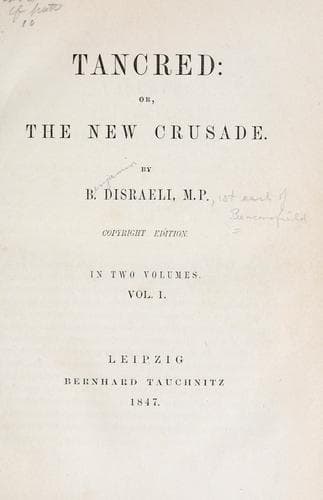
Tancred; Or, The New CrusadeDisraeli, Benjamin, Earl of Beaconsfield
ReligionJewish
Tancred; Or, The New Crusade
Disraeli, Benjamin, Earl of Beaconsfield
Christianity and other religions -- Judaism -- Fiction; Judaism -- Relations -- Christianity -- Fiction
The stars were shining before they quitted the Arabian tabernacle of
Besso. The air was just as soft as a sweet summer English noon, and
quite as still. The pavilions of the terrace and the surrounding bowers
were illuminated by the varying tints of a thousand lamps. Bright
carpets and rich cushions were thrown about for those who cared to
recline; the brothers Farhi, for example, and indeed most of the men,
smoking inestimable nargilehs. The Consul-General Laurella begged
permission to present Lord Montacute to his daughters Thérèse and
Sophonisbe, who, resolved to show to him that Damascus was not
altogether so barbarous as he deemed it, began talking of new dances and
the last opera. Tancred would have found great difficulty in sustaining
his part in the conversation, had not the young ladies fortunately been
requested to favour those present with a specimen of the art in which
they excelled, which they did after much solicitation, vowing that they
had no voice to-night, and that it was impossible at all times to sing
except in a chamber.
‘For my part,’ said Hillel Besso, with an extremely piquant air, ‘music
in a chamber is very charming, but I think also in the open air it is
not so bad.’
Tancred took advantage of this movement to approach Eva, who was
conversing, as they took their evening walk, with the soft-eyed
sister of Hillel and Madame Nassim Farhi; a group of women that the
drawing-rooms of Europe and the harems of Asia could perhaps not have
rivalled.
‘The Mesdemoiselles Laurella are very accomplished,’ said Tancred,
‘but at Damascus I am not content to hear anything but sackbuts and
psalteries.’
‘But in Europe your finest music is on the subjects of our history,’
said Eva.
‘Naturally,’ said Tancred, ‘music alone can do justice to such themes.
They baffle the uninspired pen.’
‘There is a prayer which the Mesdemoiselles Laurella once sang, a prayer
of Moses in Egypt,’ said Madame Nassim, somewhat timidly. ‘It is very
fine.’
‘I wish they would favour us with it,’ said Eva; ‘I will ask Hillel to
request that kindness;’ and she beckoned to Hillel, who sauntered toward
her, and listened to her whispered wish with a smile of supercilious
complacency.
‘At present they are going to favour us with Don Pasquale,’ he said,
shrugging his shoulders. ‘A prayer is a very fine thing, but for my
part, at this hour, I think a serenade is not so bad.’
‘And how do you like my father?’ said Eva to Tancred in a hesitating
tone, and yet with a glance of blended curiosity and pride.
‘He is exactly what Sidonia prepared me for; worthy not only of being
your father, but the father of mankind.’
‘The Moslemin say that we are near paradise at Damascus,’ said Madame
Nassim, ‘and that Adam was fashioned out of our red earth.’
‘He much wished to see you,’ said Eva, ‘and your meeting is as
unexpected as to him it is agreeable.’
Public-domain text, read in full here on John Shaqi.
Reviews
Reviews
No reviews yet
Be the first to share your thoughts on this work.
Elsewhere in the archive
Join the Discussion
Join the discussion
Sign in to leave a comment or review.
Sign InorCreate an account