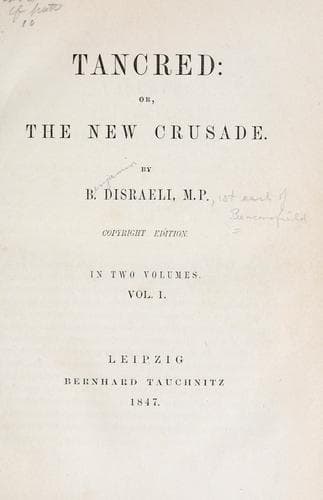
Tancred; Or, The New CrusadeDisraeli, Benjamin, Earl of Beaconsfield
ReligionJewish
Tancred; Or, The New Crusade
Disraeli, Benjamin, Earl of Beaconsfield
Christianity and other religions -- Judaism -- Fiction; Judaism -- Relations -- Christianity -- Fiction
‘The Prince of England has expressed himself with extreme exactitude,
and with flattering grace,’ replied Keferinis. ‘I have indeed visited
all the Syrian cities, except Jerusalem, which no one wishes to see, and
which,’ he added, in a sweet calm tone, ‘is unquestionably a place fit
only for hogs.’
Tancred started, but repressed himself.
‘Have you been in Lebanon?’ asked Fakredeen.
‘Noble Emir, I have been the guest of princes of your illustrious house.
Conversations have passed between me and the Emir Bescheer,’ he added,
with a significant look. ‘Perhaps, had events happened which did not
occur, the great Emir Bescheer might not at this moment have been a
prisoner at Stamboul, among those who, with infinite exactitude, may be
described as the most obscene sons of very intolerable barbarians.’
‘And why did not you and the Emir Bescheer agree?’ inquired Fakredeen,
eagerly. ‘Why has there never been a right understanding between your
people and the House of Shehaab? United, we should not only command
Syria, but we might do more: we might control Asia itself!’
‘The noble Emir has expressed himself with inexpressible grace. The
power of the Ansarey cannot be too highly estimated!’
‘Is it true that your sovereign can bring five and twenty thousand men
into the field?’ asked Tancred.
‘Five and twenty thousand men,’ replied Keferinis, with insinuating
courtesy, ‘each of whom could beat nine Maronites, and consequently
three Druses.’
‘Five and twenty thousand figs for your five and twenty thousand men!’
exclaimed Fakredeen laughing.
At this moment entered four pages and four maidens bringing sweetmeats
from the Queen, and goblets of iced water. They bowed; Keferinis
indicated their purpose, and when they had fulfilled their office
they disappeared; but the seasonable interruption had turned the
conversation, and prevented Fakredeen making a sharp retort. Now they
talked of the Queen, who, Keferinis said, would be graciously pleased
not to see them to-day, and might not even see them for a week, which
agreeable intelligence was communicated in the most affable manner, as
if it were good news, or a compliment at least.
‘The name of the Queen’s father was Suedia,’ said Fakredeen.
‘The name of the Queen’s father was Suedia,’ replied Keferinis.
‘And the name of the Queen’s mother----’
‘Is of no consequence,’ observed Keferinis, ‘for she was a slave, and
not one of us, and therefore may with singular exactitude be described
as nothing.’
‘Is she the first Queen who has reigned over the Ansarey?’ inquired
Tancred.
‘The first since we have settled in these mountains,’ replied Keferinis.
‘And where were you settled before?’ inquired Fakredeen.
‘Truly,’ replied Keferinis, ‘in cities which never can be forgotten, and
therefore need never be mentioned.’
Public-domain text, read in full here on John Shaqi.
Reviews
Reviews
No reviews yet
Be the first to share your thoughts on this work.
Elsewhere in the archive
Join the Discussion
Join the discussion
Sign in to leave a comment or review.
Sign InorCreate an account