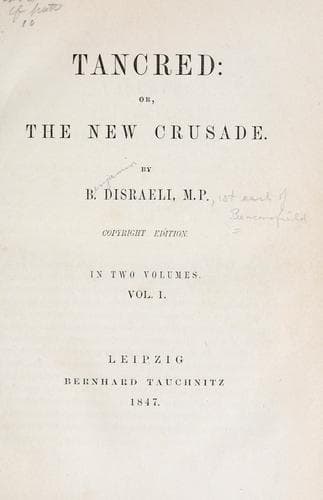
Tancred; Or, The New CrusadeDisraeli, Benjamin, Earl of Beaconsfield
ReligionJewish
Tancred; Or, The New Crusade
Disraeli, Benjamin, Earl of Beaconsfield
Christianity and other religions -- Judaism -- Fiction; Judaism -- Relations -- Christianity -- Fiction
Giselle, worthy successor of the softhearted women of Galilee, herself
the sister of the Emperor Henry the Second, who opened the mind of her
husband, the King of Hungary, to the deep wisdom of the Hebrews, to the
laws of Moses and the precepts of Jesus. Poland also found an apostle
and a queen in the sister of the Duke of Bohemia, and who revealed to
the Sarmatian Micislas the ennobling mysteries of Sinai and of Calvary.
Sons of Israel, when you recollect that you created Christendom, you may
pardon the Christians even their _autos da fè!_
Fakredeen Shehaab, Emir of Canobia, and lineal descendant of the
standard-bearer of the Prophet, had not such faith in Arabian principles
as to dream of converting the Queen of the Ansarey. Quite the reverse;
the Queen of the Ansarey had converted him. From the first moment he
beheld Astarte, she had exercised over him that magnetic influence
of which he was peculiarly susceptible, and by which Tancred at once
attracted and controlled him. But Astarte added to this influence a
power to which the Easterns in general do not very easily bow: the
influence of sex. With the exception of Eva, woman had never guided the
spirit or moulded the career of Fakredeen; and, in her instance, the
sovereignty had been somewhat impaired by that acquaintance of the
cradle, which has a tendency to enfeeble the ideal, though it may
strengthen the affections. But Astarte rose upon him commanding and
complete, a star whose gradual formation he had not watched, and whose
unexpected brilliancy might therefore be more striking even than
the superior splendour which he had habitually contemplated. Young,
beautiful, queenly, impassioned, and eloquent, surrounded by the
accessories that influence the imagination, and invested with
fascinating mystery, Fakredeen, silent and enchanted, had yielded his
spirit to Astarte, even before she revealed to his unaccustomed and
astonished mind the godlike forms of her antique theogony. Eva and
Tancred had talked to him of gods; Astarte had shown them to him. All
visible images of their boasted divinities of Sinai and of Calvary with
which he was acquainted were enshrined over the altars of the convents
of Lebanon. He contrasted those representations without beauty or grace,
so mean, and mournful, and spiritless, or if endued with attributes of
power, more menacing than majestic, and morose rather than sublime, with
those shapes of symmetry, those visages of immortal beauty, serene
yet full of sentiment, on which he had gazed that morning with a holy
rapture. The Queen had said that, besides Mount Sinai and Mount
Calvary, there was also Mount Olympus. It was true; even Tancred had
not challenged her assertion. And the legends of Olympus were as old as,
nay, older than, those of the convent or the mosques.
Public-domain text, read in full here on John Shaqi.
Reviews
Reviews
No reviews yet
Be the first to share your thoughts on this work.
Elsewhere in the archive
Join the Discussion
Join the discussion
Sign in to leave a comment or review.
Sign InorCreate an account