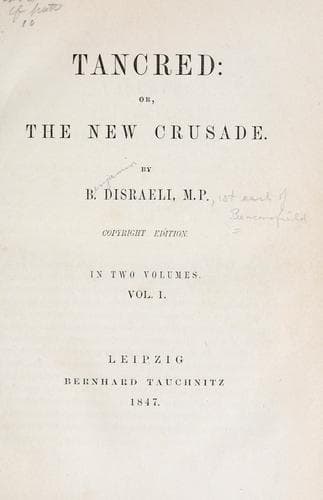
Tancred; Or, The New CrusadeDisraeli, Benjamin, Earl of Beaconsfield
ReligionJewish
Tancred; Or, The New Crusade
Disraeli, Benjamin, Earl of Beaconsfield
Christianity and other religions -- Judaism -- Fiction; Judaism -- Relations -- Christianity -- Fiction
Seven years, to such people, was half a century of social experience.
They had half a dozen seasons in every year. Still, it was hard work,
and not rapid. At a certain point they stuck, as all do. Most people,
then, give it up; but patience, Buffon tells us, is genius, and Mrs.
Guy Flouncey was, in her way, a woman of genius. Their dinners were, in
a certain sense, established: these in return brought them to a certain
degree into the dinner world; but balls, at least balls of a high
calibre, were few, and as for giving a ball herself, Mrs. Guy Flouncey
could no more presume to think of that than of attempting to prorogue
Parliament. The house, however, got really celebrated for ‘the best
men.’ Mrs. Guy Flouncey invited all the young dancing lords to dinner.
Mothers will bring their daughters where there are young lords. Mrs. Guy
Flouncey had an opera-box in the best tier, which she took only to lend
to her friends; and a box at the French play, which she took only to
bribe her foes. They were both at everybody’s service, like Mr. Guy
Flouncey’s yacht, provided the persons who required them were members
of that great world in which Mrs. Guy Flouncey had resolved to plant
herself.
Mrs. Guy Flouncey was pretty; she was a flirt on principle; thus she had
caught the Marquess of Beaumanoir, who, if they chanced to meet,
always spoke to her, which gave Mrs. Guy Flouncey fashion. But Mrs. Guy
Flouncey was nothing more than a flirt. She never made a mistake; she
was born with strong social instincts. She knew that the fine ladies
among whom, from the first, she had determined to place herself, were
moral martinets with respect to any one not born among themselves.
That which is not observed, or, if noticed, playfully alluded to in
the conduct of a patrician dame, is visited with scorn and contumely if
committed by some ‘shocking woman,’ who has deprived perhaps a countess
of the affections of a husband who has not spoken to her for years.
But if the countess is to lose her husband, she ought to lose him to a
viscountess, at least. In this way the earl is not lost to ‘society.’
Public-domain text, read in full here on John Shaqi.
Reviews
Reviews
No reviews yet
Be the first to share your thoughts on this work.
Join the Discussion
Join the discussion
Sign in to leave a comment or review.
Sign InorCreate an account