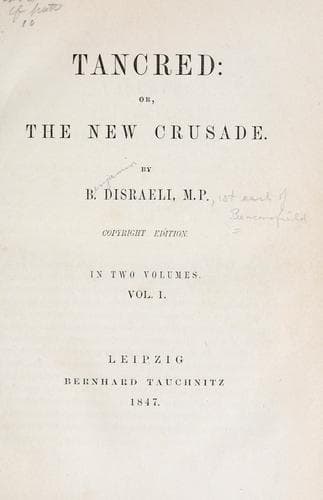
Tancred; Or, The New CrusadeDisraeli, Benjamin, Earl of Beaconsfield
ReligionJewish
Tancred; Or, The New Crusade
Disraeli, Benjamin, Earl of Beaconsfield
Christianity and other religions -- Judaism -- Fiction; Judaism -- Relations -- Christianity -- Fiction
The haunting thought that occasionally, notwithstanding his strong will,
would perplex the soul and agitate the heart of Tancred; the haunting
thought that, all this time, he was perhaps the dupe of boyish
fantasies, was laid to-day. Sometimes he had felt, Why does no one
sympathise with my views; why, though they treat them with conventional
respect, is it clear that all I have addressed hold them to be absurd?
My parents are pious and instructed; they are predisposed to view
everything I say, or do, or think, with an even excessive favour.
They think me moonstruck. Lord Eskdale is a perfect man of the world;
proverbially shrewd, and celebrated for his judgment; he looks upon me
as a raw boy, and believes that, if my father had kept me at Eton and
sent me to Paris, I should by this time have exhausted my crudities. The
bishop is what the world calls a great scholar; he is a statesman
who, aloof from faction, ought to be accustomed to take just and
comprehensive views; and a priest who ought to be under the immediate
influence of the Holy Spirit. He says I am a visionary. All this might
well be disheartening; but now comes one whom no circumstances impel to
judge my project with indulgence; who would, at the first glance, appear
to have many prejudices arrayed against it, who knows more of the world
than Lord Eskdale, and who appears to me to be more learned than
the whole bench of bishops, and he welcomes my ideas, approves my
conclusions, sympathises with my suggestions; develops, illustrates,
enforces them; plainly intimates that I am only on the threshold of
initiation, and would aid me to advance to the innermost mysteries.
There was this night a great ball at Lady Bardolfs, in Belgrave Square.
One should generally mention localities, because very often they
indicate character. Lady Bardolf lived next door to Mrs. Guy Flouncey.
Both had risen in the world, though it requires some esoteric knowledge
to recognise the patrician par-venue; and both had finally settled
themselves down in the only quarter which Lady Bardolf thought worthy of
her new coronet, and Mrs. Guy Flouncey of her new visiting list.
Lady Bardolf had given up the old family mansion of the Firebraces in
Hanover Square, at the same time that she had resigned their old title.
Politics being dead, in consequence of the majority of 1841, who, after
a little kicking for the million, satisfactorily assured the minister
that there was no vice in them.
Public-domain text, read in full here on John Shaqi.
Reviews
Reviews
No reviews yet
Be the first to share your thoughts on this work.
Elsewhere in the archive
Join the Discussion
Join the discussion
Sign in to leave a comment or review.
Sign InorCreate an account