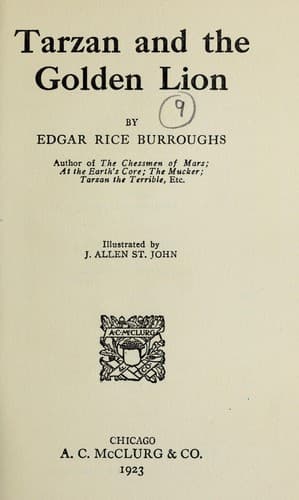
Adventure stories; Fantasy fiction; Tarzan (Fictitious character) -- Fiction
“It is very simple,” replied Obebe. “If some morning we find that he has
escaped we will know that he is the river devil, and because we have not
harmed him but have fed him well while he has been here in our village,
he will befriend us and no harm will come of it. But if he does not
escape we will know that he is Tarzan of the Apes, provided he dies a
natural death. And so, if he does not escape, we shall keep him until he
dies and then we shall know that he was, indeed, Tarzan of the Apes.”
“But suppose he does not die?” asked the witch doctor, scratching his
woolly head.
“Then,” exclaimed Obebe triumphantly, “we will know that you are right,
and that he was, indeed, the river devil.”
Obebe went and ordered women to take food to the Spaniard while the
witch doctor stood, where Obebe had left him, in the middle of the
street, still scratching his head in thought.
And thus was Esteban Miranda, possessor of the most fabulous fortune in
diamonds that the world had ever known, condemned to life imprisonment
in the village of Obebe, the cannibal.
While he had been lying in the hut his traitorous confederate, Owaza,
from the opposite bank of the river from the spot where he and Esteban
had hidden the golden ingots, saw Tarzan and his Waziri come and search
for the gold and go away again, and the following morning Owaza came
with fifty men whom he had recruited from a neighboring village and dug
up the gold and started with it toward the coast.
That night Owaza made camp just outside a tiny village of a minor chief,
who was weak in warriors. The old fellow invited Owaza into his
compound, and there he fed him and gave him native beer, while the
chief’s people circulated among Owaza’s boys plying them with
innumerable questions until at last the truth leaked out and the chief
knew that Owaza’s porters were carrying a great store of yellow gold.
When the chief learned this for certain he was much perturbed, but
finally a smile crossed his face as he talked with the half-drunken
Owaza.
“You have much gold with you,” said the old chief, “and it is very
heavy. It will be hard to get your boys to carry it all the way back to
the coast.”
“Yes,” said Owaza, “but I shall pay them well.”
“If they did not have to carry it so far from home you would not have to
pay them so much, would you?” asked the chief.
“No,” said Owaza, “but I cannot dispose of it this side of the coast.”
“I know where you can dispose of it within two days’ march,” replied the
old chief.
“Where?” demanded Owaza. “And who here in the interior will buy it?”
“There is a white man who will give you a little piece of paper for it
and you can take that paper to the coast and get the full value of your
gold.”
“Who is this white man?” demanded Owaza, “and where is he?”
“He is a friend of mine,” said the chief, “and if you wish I will take
you to him on the morrow, and you can bring with you all your gold and
get the little piece of paper.”
Public-domain text, read in full here on John Shaqi.
Reviews
Reviews
No reviews yet
Be the first to share your thoughts on this work.
Elsewhere in the archive
Join the Discussion
Join the discussion
Sign in to leave a comment or review.
Sign InorCreate an account