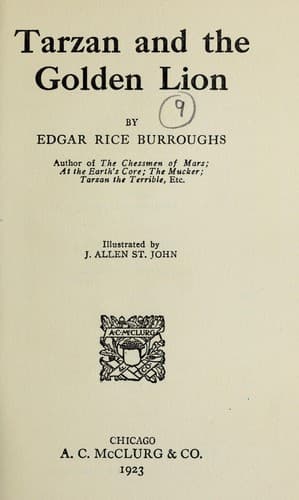
Adventure stories; Fantasy fiction; Tarzan (Fictitious character) -- Fiction
The lofty granite wall which surrounded the entire enclosure was pierced
by but a single gate which opened opposite the east end of the palace.
This gate was large and of massive construction, appearing to have been
built to withstand the assault of numerous and well-armed forces. So
strong did it appear that the ape-man could not but harbor the opinion
that it had been constructed to protect the interior against forces
equipped with heavy battering rams. That such a force had ever existed
within the vicinity in historic times seemed most unlikely, and Tarzan
conjectured, therefore, that the wall and the gate were of almost
unthinkable antiquity, dating, doubtless, from the forgotten age of the
Atlantians, and constructed, perhaps, to protect the builders of the
Palace of Diamonds from the well-armed forces that had come from
Atlantis to work the gold mines of Opar and to colonize central Africa.
While the wall, the gate, and the palace itself, suggested in many ways
almost unbelievable age, yet they were in such an excellent state of
repair that it was evident that they were still inhabited by rational
and intelligent creatures; while upon the south side Tarzan had seen a
new tower in process of construction, where a number of blacks working
under the direction of Bolgani were cutting and shaping granite blocks
and putting them in place.
Tarzan had halted in a tree near the east gate to watch the life passing
in and out of the palace grounds beneath the ancient portal, and as he
watched, a long cavalcade of powerful Gomangani emerged from the forest
and entered the enclosure. Swung in hides between two poles, this party
was carrying rough-hewn blocks of granite, four men to a block. Two or
three Bolgani accompanied the long line of carriers, which was preceded
and followed by a detachment of black warriors, armed with battle-axes
and spears. The demeanor and attitude of the black porters, as well as
of the Bolgani, suggested to the ape-man nothing more nor less than a
caravan of donkeys, plodding their stupid way at the behest of their
drivers. If one lagged he was prodded with the point of a spear or
struck with its haft. There was no greater brutality shown than in the
ordinary handling of beasts of burden the world around, nor in the
demeanor of the blacks was there any more indication of objection or
revolt than you see depicted upon the faces of a long line of
burden-bearing mules; to all intents and purposes they were dumb, driven
cattle. Slowly they filed through the gateway and disappeared from
sight.
Public-domain text, read in full here on John Shaqi.
Reviews
Reviews
No reviews yet
Be the first to share your thoughts on this work.
Elsewhere in the archive
Join the Discussion
Join the discussion
Sign in to leave a comment or review.
Sign InorCreate an account