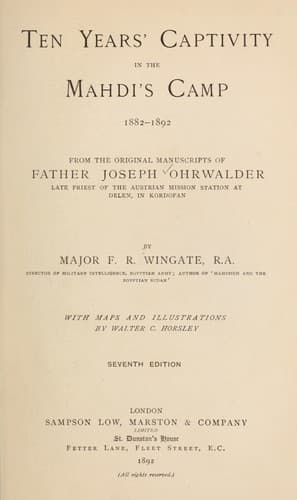
Ten Years' Captivity in the Mahdi's Camp 1882-1892Ohrwalder, Josef
Religion
Ten Years' Captivity in the Mahdi's Camp 1882-1892
Ohrwalder, Josef
Mahdi, Muhammad Ahmad, 1848-1885; Sudan -- History
System of public security and justice in Omdurman--The court of
small causes--Bribery and corruption--The story of the slave and
her mistress--How the Khalifa deals with quarrelsome
persons--Thieves and pickpockets--The story of Zogheir--Usurers and
their trade--The chief of police--Brigandage--Disproportion of
males to females in Omdurman--How the Khalifa overcame the
difficulty--Immorality--The marriage ceremony.
It may be imagined that fear of the Khalifa and his tyrannical rule
would produce at least a feeling of public security and immunity from
lawlessness; but the following chapter will show that this is not the
case.
In the early years of Mahdiism there was no discipline, and laws were
entirely put aside, because the whole population was at war and everyone
on the move. They were living on the captured wealth and prosperity of
the Government. At that time there were not many robbers. When we were
living in Kordofan we were perfectly safe, and could sleep with our
doors open at night. No one ever thought of taking precautions against
thieves, though nothing would have been easier than to break into our
loosely-built straw huts.
After the capture of Khartum, and when Omdurman became a large city, the
former prosperity of the country gradually began to wane, famine broke
out, and then public security became seriously threatened. Thieves
increased in such alarming numbers as to be a terror to all; and in
1888-89 they became so bad that people scarcely dared to go to sleep. It
is true the punishment of cutting off hands and feet was freely
exercised; but even this had little effect, chiefly because robbery and
corruption went hand in hand, and a thief had no difficulty in disposing
of a bribe.
As I have already narrated, the Khalifa nominated his own judges, with
Ahmed the Kadi el Islam as their head; a special court was also
established to deal with the innumerable marriage disputes which form so
large a part of Moslem legislation. Abdullah specially instructed his
judges to consider these cases from their external rather than from
their internal aspect.
The usual proofs required are the evidence on oath of witnesses. The
witness is obliged to wash himself before taking an oath, so that he may
be pure. He then places his right hand on the Kuran, and says, "Hakk
kitab Allah" ("By God's book"), following it by his statement. In cases
of complaints, the defendant only has the right to take an oath, whereas
the complainant must produce witnesses. If no witnesses are forthcoming,
the defendant has only to take an oath, and is then acquitted.
The real sense and meaning of an oath is absolutely ignored. Hundreds of
oaths are taken every day in the market court on the smallest trifle,
perhaps not exceeding a piastre. The falsehood of the individual taking
the oath is frequently quite apparent; but unless the witnesses come
forward, the most flagrant case will go unpunished.
Public-domain text, read in full here on John Shaqi.
Reviews
Reviews
No reviews yet
Be the first to share your thoughts on this work.
Elsewhere in the archive
Join the Discussion
Join the discussion
Sign in to leave a comment or review.
Sign InorCreate an account