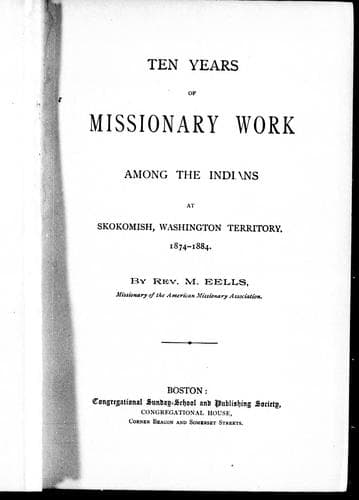
Ten years of missionary work among the Indians at Skokomish, Washington Territory, 1874-1884Eells, Myron
Religion
Ten years of missionary work among the Indians at Skokomish, Washington Territory, 1874-1884
Eells, Myron
Clallam Indians -- Missions; Missions -- Washington (State); Skokomish Indian Reservation (Wash.); Twana Indians -- Missions
Clallams are much more natural singers than the Twanas. For this reason,
and also because there have never been enough whites in church to do the
singing for them, there has never been any difficulty in inducing them
to sing in church. But for very many years it was different with the
Twanas. When the services were first begun among them the singing was in
English and they were not expected to take part in it. When hymns were
first made in the Chinook jargon there were so many whites to sing in
church, that the Indians did not seem to take hold. They would sing well
enough at their camps, the boys would sing loud enough when alone at the
boarding-house or outdoors, but when they came to church they were
almost mum. The whites and the school-girls did most of it. It is only
within the past year or two that a perceptible change has been made for
the better.
XL.
NATIVE MINISTRY AND SUPPORT.
But little has been done in these respects except to sow the seed, but
if the work shall continue another ten years I trust that more will be
accomplished. Since I have been here I have worked with the idea that in
time the Indians ought to furnish their own ministers and support them.
It will, however, naturally take more time to raise up a native ministry
than a native church, native Christian teachers than native Christian
scholars. These must come from our schools after long years of training.
Owing to a lack of early moral training among them,--the want of a
foundation,--the words of Paul on this subject have appeared to me to
have a striking significance, more so than among whites, although they
are true even among them: “Not a novice, lest being lifted up with pride
he fall into the condemnation of the devil.”
All people are tempted to be proud, but owing to this lack of
foundation, Indians are peculiarly so. A little knowledge puffeth up,
and, to use a common expression, they soon get the “big-head.” That
spoils them for the ministry. My first hope of this kind was that John
Palmer would turn his attention to the subject, but he had a family
before I knew him, and I never could induce him to look much in that
direction. In the spring of 1882 two young men who had been in school
from childhood took hold well. They began to talk with the Indians, to
assist me in holding meetings, and to take charge of them in my absence.
I felt that they were too young,--less than twenty-one,--and yet at
times I could see no other way to do; but I had reason to fear that both
felt proud of their position. During the next summer one of them, in
getting married, fell so low that we had to suspend him from the church
for almost a year, and the other for a time went slowly backward. Both
have come up again considerably, and the latter has done quite well for
the last year in holding lay-meetings. I pray “the Lord of the harvest,
that he will send forth laborers into his harvest.”
Public-domain text, read in full here on John Shaqi.
Reviews
Reviews
No reviews yet
Be the first to share your thoughts on this work.
Elsewhere in the archive
Join the Discussion
Join the discussion
Sign in to leave a comment or review.
Sign InorCreate an account