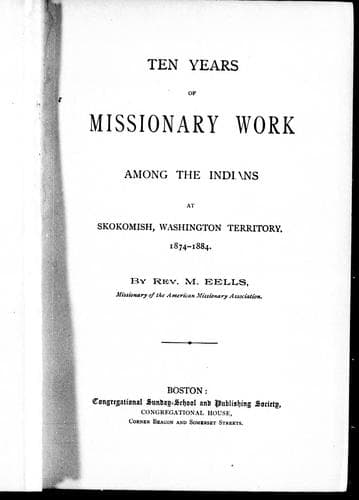
Ten years of missionary work among the Indians at Skokomish, Washington Territory, 1874-1884Eells, Myron
Religion
Ten years of missionary work among the Indians at Skokomish, Washington Territory, 1874-1884
Eells, Myron
Clallam Indians -- Missions; Missions -- Washington (State); Skokomish Indian Reservation (Wash.); Twana Indians -- Missions
The following incident shows the ideas some of them have obtained. About
1876 the school-teacher heard something going on in the boys’ room. He
quietly went to the key-hole and listened to see if any mischief were
brewing. The result was different from what he had feared. The boys were
holding a court. They had their judge and jury, witnesses and lawyers.
The culprit was charged with the crime of being drunk. After the
prosecution had rested the case, the criminal arose and said about as
follows: “May it please your honor, I am a poor man and not able to pay
a lawyer, so I shall have to defend myself. There is a little mistake
about this case. My name is Captain Chase [a white man of the region]. I
came to church on Sunday; the minister did not know me. I was well
dressed, and the minister mistook me for another minister. So when he
was done, he asked me to say a few words to the Indians. I was in a fix,
for I had a large quid of tobacco in my mouth. I tried to excuse myself,
but the minister would not take no for an answer. So at last I quietly
and secretly took out the tobacco from my mouth [suiting his words with
a very apt illustration of how it was done], threw it behind the seat,
and went up on the platform to speak. But I was not sharp enough for the
Indians. Some of them saw me throw it away, _and they thought a minister
had no business with tobacco_, and that is why I am here; besides I was
a little tipsy.” I have enjoyed telling this story to one or two
tobacco-using ministers.
Somewhat later a rather wild boy wrote me, asking me to allow him to
enter the praying band of Indian boys. He promised to give up his bad
habits; and among others he mentioned the use of tobacco, which he said
he would abandon.
Within the past year a number of the older Indians have abandoned its
use. I have a cigar which was given me by one man. He said that when he
determined to stop its use, he had a small piece of tobacco and two
cigars, and that for months afterward they lay in his house where they
were at that time, and he gave me one of them. Most of those who stopped
using it belonged to the shaking set. It was one of the few good things
which resulted from that strange affair. But they have been earnestly
encouraged to continue as they have begun in this respect.
A white man who has an Indian woman for a wife told me the following.
For years both he and his wife used tobacco, himself both chewing and
smoking. When she professed to become a Christian, she gave up her
tobacco and tried to induce him to do the same, and at last he did so
far yield as to stop smoking; but he continued to chew. All her talk did
not stop him. But he saw that when he had spit on the floor and stove,
she would get a paper or rag and wipe it up, and hence he grew ashamed
and stopped chewing in the house, using only a little--when he told
me--in the woods when at work.
XLII.
SPICE.
Public-domain text, read in full here on John Shaqi.
Reviews
Reviews
No reviews yet
Be the first to share your thoughts on this work.
Elsewhere in the archive
Join the Discussion
Join the discussion
Sign in to leave a comment or review.
Sign InorCreate an account