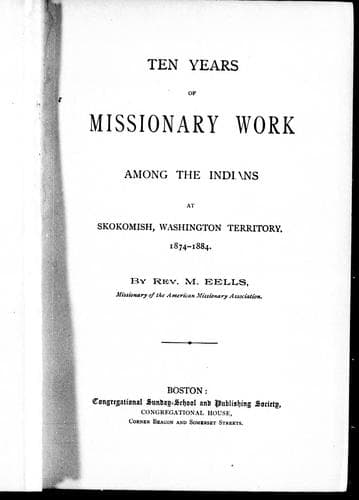
Ten years of missionary work among the Indians at Skokomish, Washington Territory, 1874-1884Eells, Myron
Religion
Ten years of missionary work among the Indians at Skokomish, Washington Territory, 1874-1884
Eells, Myron
Clallam Indians -- Missions; Missions -- Washington (State); Skokomish Indian Reservation (Wash.); Twana Indians -- Missions
Only once have I ever felt that there was much danger in traveling in a
canoe. I was coming from Clallam Bay to Jamestown in November, 1883,
with five Indians. We left Port Angeles on the afternoon of the last day
with a good wind, but when we had been out a short time and it was
almost dark, a low, black snow-squall struck us. There was no safe place
to land, and we went along safely until we reached the Dunginess Spit,
which is six miles long. There is a good harbor on the east side of it;
but we were on the west side, and the Indians said that it was not safe
to attempt to go around it, for those snow-squalls are the worst storms
there are, and the heavy waves at the point would upset us. It was
better to run the risk of breaking our canoe while landing than to run
the risk of capsizing in those boiling waters. So we made the attempt,
but could not see how the waves were coming in the darkness, and after
our canoe touched the beach, but before we could draw it up to a place
of safety, another wave struck it, and split it for nearly its whole
length. But we were all safe. Fortunately we were only seven miles from
Jamestown; so we took our things on our backs and walked the rest of the
way, all of us very thankful that we were not at the bottom of the sea.
XXXV.
THE BIBLE AND OTHER BOOKS.
Naturally most of the Indians did not care to buy Bibles at first. They
were furnished free to the school-children, and, like many other things
that cost nothing, were not very highly prized, nor taken care of half
as well as they ought to have been. Still they learned that it was the
sacred Book and when one after another left school most of them
possessed a Bible. I had not been here long when an Indian bought one,
and, having had the family record of a white friend of his written in
it, he presented it to the man, who had none. It caused some comment
that an Indian should be giving a Bible to a white man. When the first
apprentices received their first pay, a good share of their earnings
were invested in much better Bibles than they had previously been able
to buy.
The following item appeared in _The San Francisco Pacific_ in March,
1880:--
“LO, THE POOR INDIAN!
“The following facts speak volumes. Let all read them.--[Chaplain
Stubbs, Oregon Editor.]
Public-domain text, read in full here on John Shaqi.
Reviews
Reviews
No reviews yet
Be the first to share your thoughts on this work.
Elsewhere in the archive
Join the Discussion
Join the discussion
Sign in to leave a comment or review.
Sign InorCreate an account