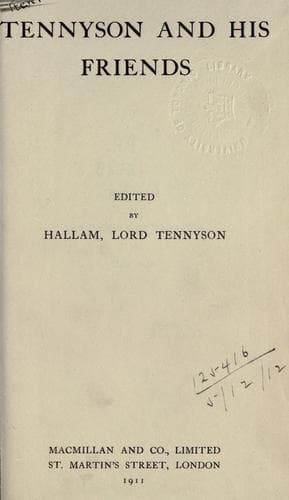
Tennyson, Alfred Tennyson, Baron, 1809-1892 -- Friends and associates
My father now bought a small estate between Yarmouth and Freshwater, and
built a house--Heathfield--upon it, in which to spend his holidays. The
Freshwater side of the Isle of Wight was not at that time a fashionable
neighbourhood. The lovely, lonely bays on the blue Solent, innocent of
lodging-house or bathing-machine, succeeded each other from Yarmouth to
the Needles. They were approached over open land, or by little stony
chines, deep in gorse and bracken, down which tiny streams trickled, to
spread themselves out shiningly on the sands and melt into the sea. I
remember my young mother killing a red adder in our chine with a
well-aimed stone, as we came up from our morning dip in the waves. There
was room for wild creatures and open country and for poetry then on the
little island. The islanders, smugglers from generation to generation, had
in them more of the wild creature than of poetry. Droll stories used to be
told of their inability to appreciate the honour done to Freshwater by the
Poet's residence there. But perhaps the days when his "greatness" was
measured by the man-servant test[47] were more comfortable days for the
Bard than those when his movements were marked and followed through
telescopes.
There was a constant coming and going between Heathfield and Farringford,
the children of each house being equally at home in the other. I see now
the long Farringford drawing-room, full of the green shade of a cedar tree
which grew near the great window, and the slight figure of Lady Tennyson
rising from the red sofa--it was a red room--and gliding towards my mother
with a smile upon her lips. She always wore a soft gray cashmere gown, and
it was always made in the same simple fashion; much as dresses were worn
in the days of Cruikshank, only that the gathered skirt was longer and
less full than the skirts of Cruikshank's ladies. Her silky auburn-brown
hair, partly hidden by lace lappets, was untouched with gray, and her
complexion kept its rose-leaf delicacy, just as her strong and cultivated
intellect kept its alertness, to the last days of her life. No sooner were
the greetings over than ten to one the door would open, and the Poet would
come slowly, softly, silently, into the room, dressed in an old-fashioned
black tail-coat, and fixing my mother with his distant short-sighted gaze.
One day, she being seated with her back to the cedar-green window, he
approached her with such extreme deference, and so solemn a courtesy, as
made her all amazed; until in a minute, with a flash of amusement, both
discovered that he had mistaken her for--the Queen. Still more surely one
or both of the long-haired, gray-tunicked boys would appear, less
silently; and away the children scampered to their endless play about the
rambling house and grounds. But even the children's play was informed with
the vital interest of the two houses: the story of King Arthur and his
knights. The first "Idylls of the King" had appeared, and others were
appearing.
Public-domain text, read in full here on John Shaqi.
Reviews
Reviews
No reviews yet
Be the first to share your thoughts on this work.
Elsewhere in the archive
Join the Discussion
Join the discussion
Sign in to leave a comment or review.
Sign InorCreate an account