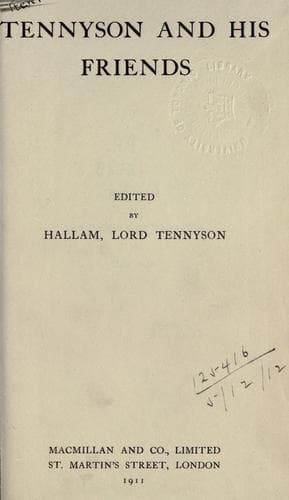
Tennyson, Alfred Tennyson, Baron, 1809-1892 -- Friends and associates
peaceful beauty of Marlborough and its landscape, and also in the wealth
of flowers with which my mother surrounded herself in her house and
garden; for she was a great gardener before it became fashionable to be
so. In the drawing-room at the Lodge, masters and their wives--then all
young--and Sixth Form boys gathered around the Poet. At that time he had
for years been living a life apart from the crowd, and it must have been
an effort to him to project himself into this young and wholly strange
school society. But he did it gallantly and seemed happy among the young
people. There were science evenings and poetry evenings. That is, there
were evenings when masters interested in science exhibited the wonders of
the microscope, and evenings when Tennyson read aloud his own poetry or
Hood's comic verses. I remember well being allowed to stay up to hear him
read "Guinevere" to the Upper Sixth Form. He had a great deep voice like
the booming of waves in a sea-cave, and although the situation in the poem
was not one to appeal to a child, yet his reading of the farewell of
Arthur to Guinevere affected me so much that I crawled into a corner and
wept two pocket-handkerchiefs full of tears.
During this visit Tennyson, who suffered sometimes from nervous
depression, said more than once that he envied my father's life of active
and incessant goodness. In the man who at the height of his fame could
experience and express such a feeling, there was still something of the
heart of a good child--its simplicity, its humility, its "wanting to be
good."
In June 1867, Aldworth--called at first Greenhill--appears in the letters.
Emily Tennyson writes to my mother: "We have agreed to buy thirty-five[48]
acres of beautifully situated land. It is a ledge on a hill nearly 1000
feet high, all copse and foxgloves almost, and a steep descent of wood and
field below; the ledge looking over an immense plain, and backed by a hill
slightly higher than itself." I quote what follows because it shows how
simple had been the Freshwater life. "The order is gone for a small
sociable landau. This seems so luxurious that I am afraid I am perversely
more ready to cry than to laugh over it."
Public-domain text, read in full here on John Shaqi.
Reviews
Reviews
No reviews yet
Be the first to share your thoughts on this work.
Elsewhere in the archive
Join the Discussion
Join the discussion
Sign in to leave a comment or review.
Sign InorCreate an account