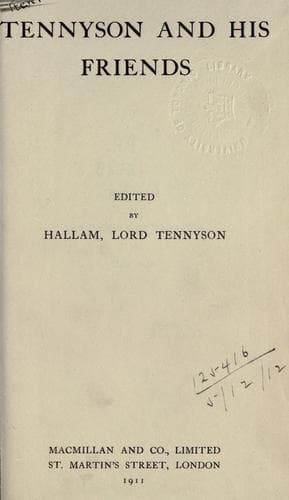
Tennyson, Alfred Tennyson, Baron, 1809-1892 -- Friends and associates
My mother writes of Tennyson in 1888, after thirty-three years of
friendship, "he grows more and more unselfish and thoughtful for others."
She noted how the self-absorption and melancholy of his earlier years
passed away in the calm sunshine of his old age.
The passing years had brought changes to others. The brilliant little
scholar with the tongue which had once held in check the boldest offender
against the laws of God or the Latin Grammar--although it never smote to
defend or advance himself--had ripened into the constant peacemaker; one
of the gentlest and humblest of that little band, who really walk in the
footsteps of their Master Christ, and make those footsteps clearer for
ever to all whose privilege it has been to live in their intimacy.
At length the day came when, full of years and honours, the famous singer,
the Great Voice of Victorian England, lay silenced in the solemn shade of
Westminster Abbey, with the clamour of London about him instead of the
roar of his sea. It was his old friend, he who had walked and talked with
him those long hours of the summer day and night thirty-seven years
before, who pronounced the last blessing above his grave. And now that
friend also sleeps, as it were, in the next room.
NOTES ON CHARACTERISTICS OF TENNYSON
By the late MASTER OF BALLIOL (PROFESSOR JOWETT)
Absolute truthfulness, absolutely himself, never played tricks.
Never got himself puffed in the newspapers.
A friend of liberty and truth.
Extraordinary vitality.
Great common sense and a strong will.
The instinct of common sense at the bottom of all he did.
Not a man of the world (in the ordinary sense) but a man who had the
greatest insight into the world, and often in a word or a sentence would
flash a light.
Intensely needed sympathy.
A great and deep strength.
He mastered circumstances, but he was also partly mastered by them, _e.g._
the old calamity of the disinheritance of his father and his treatment by
rogues in the days of his youth.
Very fair towards other poets, including those who were not popular, such
as Crabbe.
He had the high-bred manners not only of a gentleman but of a great man.
He would have wished that, like Shakespeare, his life might be unknown to
posterity.
_Conversation._
In the commonest conversation he showed himself a man of genius. He had
abundance of fire, never talked poorly, never for effect. As Socrates
described Plato, "Like no one whom I ever knew before."
The three subjects of which he most often spoke were "God," "Free-Will,"
and "Immortality," yet always seeming to find an (apparent) contradiction
between the "imperfect world," and "the perfect attributes of God."
Great charm of his ordinary conversation, sitting by a very ordinary
person and telling stories with the most high-bred courtesy, endless
stories, not too high or too low for ordinary conversation.
The persons and incidents of his childhood very vivid to him, and the
Lincolnshire dialect and the ways of life.
Public-domain text, read in full here on John Shaqi.
Reviews
Reviews
No reviews yet
Be the first to share your thoughts on this work.
Elsewhere in the archive
Join the Discussion
Join the discussion
Sign in to leave a comment or review.
Sign InorCreate an account