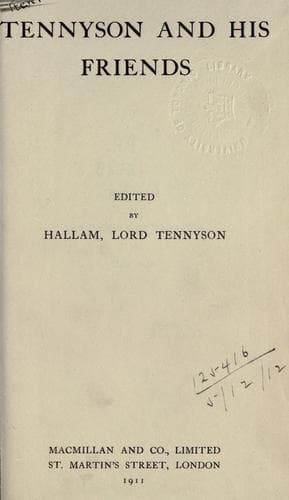
Tennyson, Alfred Tennyson, Baron, 1809-1892 -- Friends and associates
and it is what you asked for. And let me make two preliminary remarks. In
reference to the defect of self-imputation above mentioned, I wish to
point out to any, consciously or unconsciously, critically minded person,
that the striking thing to me was the wide sympathy, the catholicity of
the Poet's mind, his width of view. Thus he--I will not use the word
"displayed," as if it were an external habit of any sort--but simply and
naturally he had ingrained in him the greatest generosity in his feeling
for, in his criticism of, contemporary authors. And this applies to his
appreciation of the great classical authors of the past. I do not say, of
course, that he had not his favourites, as we all have, especially,
perhaps, the smaller we are. For instance--and here other of his
contemporaries, Clough, Jowett, etc., would have borne him out--his
appreciation of [Greek: D]'s favourite poet Shelley was not so spontaneous
nor, I venture to think, so profound as, let us say, his appreciation of
Wordsworth (whom he also "criticized"[53]) or Victor Hugo, or, to take an
opposite instance, his ready appreciation of Walt Whitman, or of Browning,
or possibly of Clough. But all this is admirably discussed in your
_Memoir_.[54] I only wish to add my testimony, and I take as my text a
saying of his about Goethe, which I seem to recollect if I recollect
rightly: "In his smaller poems, _e.g._ those in _Wilhelm Meister_, Goethe
shows himself to be one of the great artists of the world. He is also a
great critic, yet he always said the best he could of an author. Good
critics are rarer than good authors" (cp. his own "And the critic's rarer
still").[55]
And I must further premise that the samples given of quotations from the
Classics are from the particular ones he chanced upon--the artist in him,
perhaps, instinctively selecting--for the particular youth, and what he
needed, or because they fitted on to things on which his mind was working
at that date. Here, at all events, they are, or some of them. I omit
continual references to Shakespeare, to Dante, to Virgil, to Homer. He was
perpetually quoting Homer and Virgil, and to my mind there was nothing for
grandeur of sound like his pronunciation of Latin and Greek as he recited
whole passages or single lines in illustration of some point, of metre,
perhaps, or thought, or feeling; for instance, the line from Homer:
[Greek: bê d' akeôn para thina polyphloisboio thalassês],
commenting on the possibility of pronouncing [Greek: oi] not in our
English fashion like _oy_ in _boy_, but like the German _ö_--_o_ of
"wood"--_phlösböo_--imitating the lisping whisper of the tideless
Mediterranean on a soft summer day. Then how he rolled out his Virgil,
giving first the thunder, then the wash of the sea in these lines:
Public-domain text, read in full here on John Shaqi.
Reviews
Reviews
No reviews yet
Be the first to share your thoughts on this work.
Elsewhere in the archive
Join the Discussion
Join the discussion
Sign in to leave a comment or review.
Sign InorCreate an account