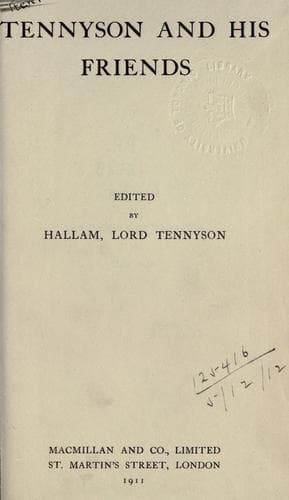
Tennyson, Alfred Tennyson, Baron, 1809-1892 -- Friends and associates
Mourn, all ye Goddesses of Love, and all ye Cupids mourn: mourn, all
ye sons of men that know what love is. My lady's sparrow is dead,
dead; her sparrow, my lady's pet, whom she loved more than her own
eyes, for he was honey-sweet, and knew his own mistress as well as any
girl her mother; nor would he stir from his lady's bosom, but hopping
about, now here, now there, he piped his little treble to her and her
alone. But now he goes along the darksome road, to that place whence
they say no one returns. Ah, my curse upon you! Cursed shades of
Orcus, that devour all things beautiful! So beautiful a sparrow have
ye taken from me! Alas for the ill deed done! Alas, poor little[57]
sparrow! Now, because of you my lady's dear eyes are swollen, they are
red with weeping.
The tenderness of his voice when he came to the eleventh and twelfth
lines, and the measured outburst of passionate imprecation, come back
almost audibly. I wish I could reproduce the pathos. But in the poem he
next read to me, the tenderness of Catullus and his perfection of form
reach, I think, a climax. So I think he felt, he who so revived his manner
in "Frater Ave atque Vale," and his reading gave me that impression. I
refer to the passionate poem:
Vivamus, mea Lesbia, atque amemus,
Rumoresque senium severiorum
Omnes unius aestimemus assis.
Soles occidere et redire possunt:
Nobis cum semel occidit brevis lux,
Nox est perpetua una dormienda.[58]
Da mi basia mille, deinde centum,
Dein mille altera, dein secunda centum,
Deinde usque altera mille, deinde centum.
Dein, quum millia multa fecerimus,
Conturbabimus illa, ne sciamus,
Aut nequis malus invidere possit,
Cum tantum sciat esse basiorum.
Let us live, my Lesbia, live and love; and, as for the slanderous
tongues of greybeards, value them all at a farthing's worth. Suns may
set and suns may rise again, but for us, when our short day has ended,
one long night comes, a night of sleep that knows no ending. Give me a
thousand kisses, then a hundred, and then another thousand and a
second hundred, and then once more a thousand and again a hundred, on
and on. And then, when we have made up many thousands, we will
overturn the reckoning that we may not know the number, nor any
villain cast an evil eye on us, though he discover all that huge
amount of kisses.
Can't you overhear his voice? _Conturbabimus illa, ne sciamus_, deep-toned
and fast, like a pent-up stream in spate, bursting its barriers, till the
tale is told.
Two other poems of Catullus I must mention. The first of these he had much
on his mind, for he was just then in the mood for experiments on metre,
and the famous poem "Boädicea" was, I think, the first of these,[59]
echoing the galliambics of Catullus in the "Attis":
Super alta vectus Attis celeri rate maria.
Public-domain text, read in full here on John Shaqi.
Reviews
Reviews
No reviews yet
Be the first to share your thoughts on this work.
Elsewhere in the archive
Join the Discussion
Join the discussion
Sign in to leave a comment or review.
Sign InorCreate an account