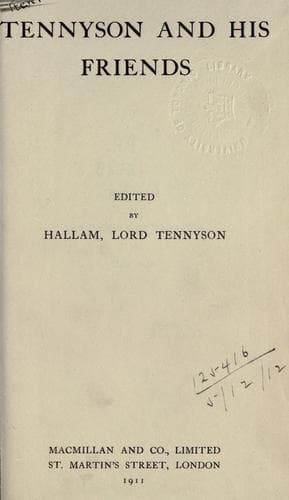
Tennyson, Alfred Tennyson, Baron, 1809-1892 -- Friends and associates
It was natural also that the heroic poems of Simonides should have
appealed to both men, and of special interest to know the delight that
Tennyson took in one of these, and perhaps because of the similarity shown
by his own splendid lines in the "Duke of Wellington" Ode:
He, that ever following her commands,
On with toil of heart and knees and hands,
Thro' the long gorge to the far light has won
His path upward, and prevail'd,
Shall find the toppling crags of Duty scaled
Are close upon the shining table-lands
To which our God Himself is moon and sun.
[Greek: esti tis logos
tan aretan naiein dysambatois epi petrais;
hagnan de min thean chôron hagnon amphepein.
oude pantôn blepharois thnatôn esoptos,
ô mê dakethymos hidrôs
endothen molê, hikê t' es akron
andreias.]
There is a tale
That Valour dwells above the craggy peaks
Hard, hard to scale,
A goddess pure in a pure land, and none
May see her face,
Save those who by keen Toil and sweat have won
That highest place,
That goal of manhood.
And with these heroic lines go the others on the men who fell at
Thermopylae:
[Greek: tôn en Thermopylais thanontôn
eukleês men ha tycha, kalos d' ho potmos,
bômos d' ho taphos, pro goôn de mnastis, ho d' oiktos epainos:
entaphion de toiouton out' eurôs
outh' ho pandamatôr amaurôsei chronos.
andrôn agathôn hode sakos oiketan eudoxian
Hellados heileto: martyrei de Leônidas,
ho Spartas basileus, aretas megan leloipôs
kosmon aenaon te kleos.]
Of those who fell at far Thermopylae,
Fair is the fate and high the destiny:
Their tomb an altar, memory for tears
And praise for lamentation through the years.
On such a monument comes no decay,
And Time that conquers all takes not away
Their greatness: for this holy Sepulchre
Of valiant men has called to dwell with her
The glory of all Greece. Bear witness, Sparta's king,
Leonidas! thy ever-flowing spring
Of fame and the high beauty of thy deed!
There is a kindred note echoing through the popular catch in praise of the
tyrannicides, Harmodius and Aristogeiton, one of the first bits of Greek
that Tennyson made his sons learn:
[Greek: en myrtou kladi to xiphos phorêsô,
hôsper Harmodios kai Aristogeitôn,
hote ton tyrannon ktanetên
isonomous t' Athênas epoiêsatên.]
In myrtle I wreathe my sword
As they wreathed it, the brave,
Brave Harmodius, Aristogeiton,
When they slew the oppressor, the lord,
And to Athens her freedom gave.
Mr. Dakyns must have rejoiced in a spirit that could feed boys on such
gallant stuff as this.
From Goethe he would have selected the noble proem to Faust:
Ihr naht Euch wieder, schwankende Gestalten,
for there was a note among his papers to that effect.
And there is one note about Béranger (written in a letter):
It was he too who introduced me to Béranger, _e.g._ "Le Roi d'Yvetot,"
and the refrain:
Public-domain text, read in full here on John Shaqi.
Reviews
Reviews
No reviews yet
Be the first to share your thoughts on this work.
Elsewhere in the archive
Join the Discussion
Join the discussion
Sign in to leave a comment or review.
Sign InorCreate an account