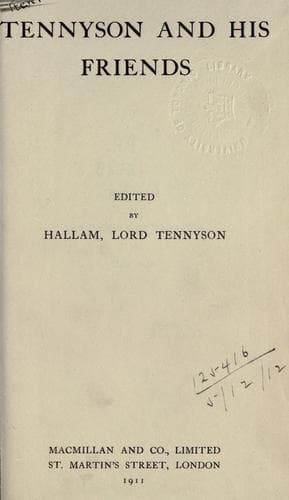
Tennyson, Alfred Tennyson, Baron, 1809-1892 -- Friends and associates
Very soon after, the Bradleys and we dined at Farringford. The dinner hour
was, I think, as early as six, and then, after he had retreated to his
_sanctum_ for a smoke, he would come down to the drawing-room, and read
aloud to his guests. On this occasion he read to us "Enoch Arden," then
only in manuscript. I had before heard much of his peculiar manner of
reading, with its deep and often monotonous tones, varied with a sudden
lift of the voice as if into the air, at the end of a sentence or a
clause. It was, as always, a reading open to criticism on the score of
lack of variety, but my dear bride and I were in no mood to criticize. The
spell was upon us. Every note of his magnificent voice spoke of majesty or
tenderness or awe. It was, in plain words, a prodigious treat to have
heard him. We walked back through the winter darkness to our hotel,
conscious of having enjoyed a unique privilege.
During this vacation I had, as often in after years, not a few walks with
him on the downs, leaving the Beacon on the left and going on to the
Needles. It was a walk of about two hours. It is here that my memory so
sadly fails me as to his talk. In tone it was friendly, manly, and
perfectly simple, without a touch of condescension. He seemed quite
unconscious that he was a great man, one of the first Englishmen of his
time, talking to one young and utterly obscure. Almost any subject
interested him, grave or gay. He would often talk of metres, Greek and
Latin; of attempts to translate Homer; of the weak points in the English
hexameter; or again of more serious topics, on which he had thought much
and felt strongly, such as the life after death, the so-called "Eternity
of Future Punishment," the unreality of the world as known to the senses,
the grander Human Race, the "crowning race," still to be born.
Occasionally, not very often in these days, he would speak of his own
poems. Once, I remember, a few days after an examination of the sixth form
at Harrow, I told him that we had set for Greek Iambics the fine passage
in "Elaine," where Lancelot says to Lavaine:
... in me there dwells
No greatness, save it be some far-off touch
Of greatness to know well I am not great.
_There_ is the man,
pointing to King Arthur. "Yes," he said in substance, "when I wrote that,
I was thinking of Wordsworth and myself."
I noticed that he never spoke of Wordsworth without marked reverence.
Obviously, with his exquisite ear for choice words and rhythm, he must
have been more sensitive than most men to the prosaic, bathetic side of
Wordsworth; but I never heard him say a word implying that he felt this,
whereas I _have_ heard him qualify his admiration for Robert Browning's
genius and his affection for his person by some allusion to the roughness
of his style. This, he thought, must lead to his being less read than he
deserved in years to come, and he evidently regretted it.
Public-domain text, read in full here on John Shaqi.
Reviews
Reviews
No reviews yet
Be the first to share your thoughts on this work.
Elsewhere in the archive
Join the Discussion
Join the discussion
Sign in to leave a comment or review.
Sign InorCreate an account