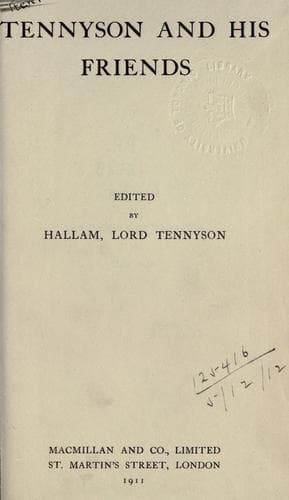
Tennyson, Alfred Tennyson, Baron, 1809-1892 -- Friends and associates
I find that in my Journal I wrote as regards this walk: "I wish I could
remember more. He was wholly _facilis_, and I never felt less afraid of
him or more reverent." Perhaps I should add that during the walk he told
me an extraordinary number of ghost stories--a man appearing to several
people, and then vanishing before their eyes.
After dinner that evening we went to his _sanctum_ to hear him read the
last Act of the "Promise of May." "Well, isn't that tragic?" he naïvely
asked at one point, I think where Eva falls down dead.
Next morning, I had to leave quite early for London. He just appeared at
the top of the stairs, and offered to come down to say good-bye, but I
would not let him. "I can remember little more of this delightful visit,"
so I wrote at the time. "He was full, as usual, of the public lies, and
the necessity of England being strong at sea."
I did not see him again till after my second marriage, which took place on
August 9, 1888. We paid a flying visit to Lambert's Hotel, Freshwater, in
April 1889. Of this I have made only the scantiest record. Something led
us to speak of the famous line in the chorus of the _Agamemnon_:
[Greek: ommatôn en achêniais.]
"So modern," he remarked. He also spoke of the pathos of Euripides, and of
the grandeur of the "Passing of Oedipus" in the _Oedipus Coloneus_, and
_Theseus_
[Greek: cheir' antechonta kratos.]
He referred again to lack of sympathy in his time between dons and
undergraduates. This seemed to be a memory often present to his mind.
Our next visit was in March 1890, when, with my wife's sister, we stayed
at Lambert's Hotel. On Friday, March 28, we went to tea at Farringford,
and found him in his little sun-trap of a summer-house, the evening sun
playing full upon us, and bringing into perfect beauty the green lawn,
the spreading trees, and the clumps of daffodils. He began by speaking of
himself as depressed, but soon smiled away all such symptoms, and made us
laugh with a story of the Duke of Wellington, when some prosy personage
addressed him with a flattering compliment. He always seemed to enjoy
anecdotes of the Great Duke. He was wearing a red cap which, in the
sunlight, became him well; but he said playfully that Lady Tennyson
disliked it as too suggestive of a "bonnet rouge." Something, I forget
what, led to a reference to the well-known verse:
Birds in the high Hall-garden
When twilight was falling,
Maud, Maud, Maud, Maud,
They were crying and calling.
He once asked a rather gushing lady what sort of birds she supposed these
to be. "Nightingales," was the rather sentimental answer. "Who ever heard
a nightingale say 'Maud'?" was the somewhat stern reply. "They were rooks
of course."
Public-domain text, read in full here on John Shaqi.
Reviews
Reviews
No reviews yet
Be the first to share your thoughts on this work.
Elsewhere in the archive
Join the Discussion
Join the discussion
Sign in to leave a comment or review.
Sign InorCreate an account