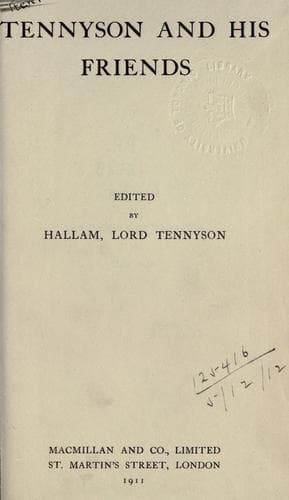
Tennyson, Alfred Tennyson, Baron, 1809-1892 -- Friends and associates
Tennyson himself had been proctorized once or twice. Once, during the
first few days of his College life, he came out to receive a parcel by
a midnight mail. "Pray, sir, what are you doing at this time of
night?" said the Proctor. "And pray, sir, what business of yours is it
to ask me?" replied the Freshman, who in his innocence knew nothing
about the Proctor. He was told to call upon him next day, but then
explained his ignorance, and was let off.
On one occasion a throng of University men outside the Senate House
had been yelling against Whewell. Tennyson was standing by the door of
Macmillan's shop, and raised a counter-cry _for_ Whewell. He was,
however, seen standing, and was sent for to Whewell. "I was surprised,
sir, to see _you_ among that shouting mob the other day." "I was
shouting _for_ you," was the reply. Whewell was greatly pleased, and
grunted his approbation.
Another funny story. A wine-party was going on in Arthur Hallam's
rooms in the New Court, when enter angrily the Senior Dean, "Tommy
Thorp." "What is the meaning, Mr. Hallam, of all this noise?" "I am
very sorry, sir," said Hallam, "we had no idea we were making a
noise." "Well, gentlemen, if you'll all come down into the Court,
you'll _hear_ what a noise you're making." "Perhaps," admits Tennyson,
"I may have put in the _all_."
So ends my wife's short journal, and it only remains for me to sum up very
briefly the impressions left upon me, after a lapse of fifty, forty,
thirty, twenty years, by these visits to Farringford which once made so
large a part of my interest and my happiness.
Little as I am able to put these impressions into words, I can say with
truth that no personality with which I have ever come in close touch,
either seemed to me at the time, or has seemed in later recollection, to
cover so large, so rich, and so diverse a field for veneration, wonder,
and regard.
Tennyson was, and is, to me the most remarkable man that I have ever met.
Often when I was with him, whether in long walks or in his study, and when
I came to think of him silently afterwards, I used to recall his own lines
on Wellington:
Our greatest yet with least pretence...,
Rich in saving common-sense,
_And, as the greatest only are,
In his simplicity sublime_.
Simple, natural, shrewd, humorous; feeling strongly on a vast variety of
subjects, and saying freely just what he felt; passing rapidly and easily
from the gravest matters of speculation or conduct to some trifling or
amusing incident of the moment, or some recollection of the years of his
youth; he seemed to me unconscious of being a great man, though he must
have known himself to be one of the foremost thinkers, and quite the
foremost poet of his day. He was wholly free from affectation. He was
never an actor of a part. There was about him always an atmosphere of
truth.
Truth-teller was our Alfred named,
Public-domain text, read in full here on John Shaqi.
Reviews
Reviews
No reviews yet
Be the first to share your thoughts on this work.
Elsewhere in the archive
Join the Discussion
Join the discussion
Sign in to leave a comment or review.
Sign InorCreate an account