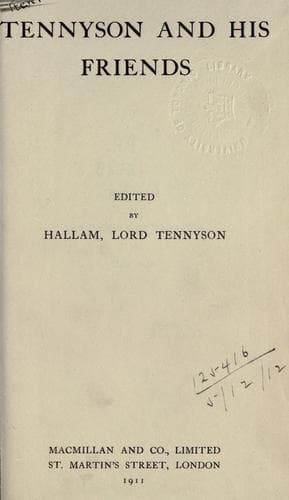
Tennyson, Alfred Tennyson, Baron, 1809-1892 -- Friends and associates
Tennyson's friendship with my father began at a date considerably
subsequent to their first acquaintance. My father came rather unexpectedly
into the family property in the Isle of Wight in 1849 when his uncle died
without a son; but he did not desire to leave the house Pugin had built
for him in Hertfordshire, where he had settled immediately after he joined
the Catholic Church in 1845. He and the late Cardinal Vaughan were, in the
'fifties, doing a work for ecclesiastical education at St. Edmund's
College, Ware--a work which came to my father naturally as the sequel to
his share in the Oxford Movement. Therefore, when Tennyson in 1853 came to
live in the Isle of Wight my father was an absentee. He tried in 1858
for two years to live at his grandfather's old home near Cowes, Northwood
Park, but his health broke down, and he returned to Hertfordshire. In the
'sixties, however, he used to pay long visits to Freshwater, in the
scenery of which he delighted; and, on one of these occasions, Tennyson
was introduced to him by their common friend, Dean Bradley. The meeting
was not, I think, a great success on either side. Later on, however, in
1870, when my father, despairing of the Cowes climate, built a house at
Freshwater, he was Tennyson's near neighbour, and they soon became great
friends.
[Illustration: ARTHUR TENNYSON.]
Tennyson's friendship with my father grew up from close neighbourhood, and
from the fact that they had so much more in common with each other than
with most of their other Isle of Wight neighbours. It was cemented by my
father's devotion to Mrs. (afterwards Lady) Tennyson, who, in her
conversation, he always said, reminded him of the John Henry Newman of
Oxford days. Also they had many friends in common--such as Dean Stanley,
Lord Selborne, and Jowett--who often visited Freshwater. They were both
members of the Metaphysical Society, and loved to discuss in private
problems of religious faith which formed the subject of the Society's
debates. They were also both great Shakespearians. But most of all they
were drawn together by a simplicity and directness of mind, in which, I
think, they had few rivals--if I may say of my own father what every one
else said. Nevertheless, their intimacy was almost as remarkable for
diversity of interests as for similarity. It might seem at first sight to
be a point of similarity between them that each revelled in his way in the
scenery of the beautiful island which was their home. Yet the love of
external nature was very different in the two men. It had that marked
contrast which Ruskin has described in his _Modern Painters_. Ruskin
contrasts three typical ways of being affected by what is beautiful. There
is first "the man who perceives rightly because he does not feel, and to
whom the primrose is very accurately the primrose because he does not love
it. Then, secondly, the man who perceives wrongly because he feels, and to
Public-domain text, read in full here on John Shaqi.
Reviews
Reviews
No reviews yet
Be the first to share your thoughts on this work.
Elsewhere in the archive
Join the Discussion
Join the discussion
Sign in to leave a comment or review.
Sign InorCreate an account