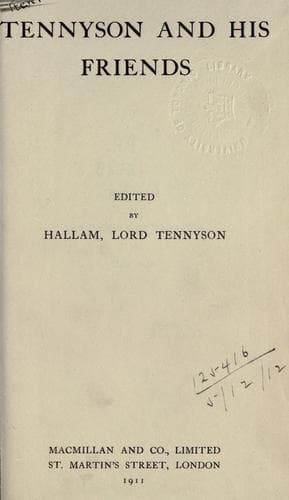
Tennyson, Alfred Tennyson, Baron, 1809-1892 -- Friends and associates
* * * * *
Love for the maiden, crown'd with marriage, no regrets for aught that has
been,
Household happiness, gracious children, debtless competence, golden mean;
National hatreds of whole generations, and pigmy spites of the village
spire;
Vows that will last to the last death-ruckle, and vows that are snapt in
a moment of fire;
He that has lived for the lust of the minute, and died in the doing it,
flesh without mind;
He that has nail'd all flesh to the Cross, till Self died out in the love
of his kind;
Spring and Summer and Autumn and Winter, and all these old revolutions of
earth;
All new-old revolutions of Empire--change of the tide--what is all of it
worth?
What the philosophies, all the sciences, poesy, varying voices of prayer?
All that is noblest, all that is basest, all that is filthy with all that
is fair?
What is it all, if we all of us end but in being our own corpse-coffins
at last,
Swallowed in Vastness, lost in Silence, drown'd in the deeps of a
meaningless Past?
What but a murmur of gnats in the gloom, or a moment's anger of bees in
their hive?
The thought which seems to oppress the seer is the insignificance of
everything when compared to a standard--ever conceivable and ever
actual--above it. The ruts of a ploughed field may seem to the diminutive
insect as vast and overcoming as the Alps seem to us. Then contrast the
thought of Mont Blanc with that of the whole globe; proceed from the globe
to the solar system, and from that to the myriads of systems lost in
space. All that is great to us is relatively great, and becomes small at
once when the mind rises higher. So, too, in the moral order, all those
aspects of human life which sway our deepest emotions are but "a murmur of
gnats in the gloom," if regard be had to our comparative insignificance.
The ground yields at every step, and the mind looks for some _terra
firma_, some absolute basis of trust, and this is only to be found in the
conception of man as possessing an eternal destiny. The infinite value of
all that concerns an immortal being stands proof against the thoughts that
bewildered our vision. "He that has nailed all flesh to the cross till
self died out in the love of his kind" may be but a speck in the universe,
but faith measures him by a standard other than that of spacial vastness.
The idea of the _eternal worth of morality_ steps in to calm the
imagination, and this idea in its measure justifies the conception of the
value and importance of all the phases of human existence which make up
the drama of life. Human Love is the side of man's nature which the poet
looks to as conveying the sense of his immortal destiny. The undying union
of spirit with spirit is a union which the grave cannot end. The
bewildering nightmare of the nothingness and vanity of all things is
Public-domain text, read in full here on John Shaqi.
Reviews
Reviews
No reviews yet
Be the first to share your thoughts on this work.
Elsewhere in the archive
Join the Discussion
Join the discussion
Sign in to leave a comment or review.
Sign InorCreate an account