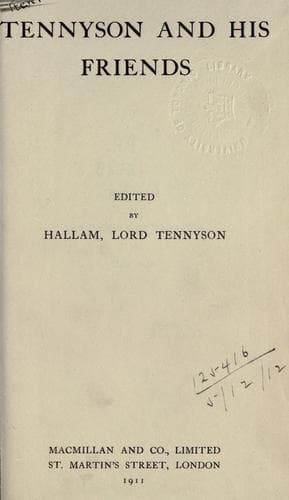
Tennyson, Alfred Tennyson, Baron, 1809-1892 -- Friends and associates
But for the suggestion of the present Lord Tennyson, I should shrink from
the presumption of posing as a friend of his illustrious father, who for
three Easters made of me a companion, sometimes for two, more often three
hours daily, for three weeks at a time together. I should be safe in
saying that the most gifted men I have ever known, Tennyson, Browning, and
Cory, were in the realms of thought, philosophy, and imagination foremost
in an age which in two instances acknowledged their supremacy whilst they
lived, and in the third has ungrudgingly admitted him as one taking high
rank amongst the English poets of the second order. I link his name with
that of the two great men, for I have abundant materials for forming my
opinion of him in the shape of three volumes of correspondence, begun in
my boyhood and continued for years during my friend's lifetime.
Mr. Fitzherbert was a welcome friend of Dr. Johnson's. "Ursa Major" warmed
to him, though perfectly conscious that Fitz was anything but a star of
the first magnitude. He says: "There was no sparkle, no brilliancy in
Fitzherbert, but I never knew a man who was so generally acceptable. He
made everybody quite easy, overpowered nobody by the superiority of his
talents, made no man think worse of himself by being his rival, seemed
always to listen, did not oblige you to hear much from him, and did not
oppose what you said." "Such characters," says Mr. Raleigh, "are the oil
of society, yet a society made wholly of such characters would have no
taste."
Tennyson's fidelity and patience with me were very much of a mystery;
possibly I may have fitted his hand as a pet walking-stick; anyhow, I was
"Man Friday to his Crusoe" as the play-actors say, and "constitutionals"
with the Poet Laureate and his dogs, a wolf-hound or a deer-hound,
Karénina or Lufra, were matters of daily occurrence in my Freshwater days.
After 5 o'clock tea I left the Poet to "his sacred half-hour," and his
pipe of tobacco. By the way, he smoked straight-stemmed Dublin clay-pipes,
and hated new pipes, which he would soak in coffee.
Public-domain text, read in full here on John Shaqi.
Reviews
Reviews
No reviews yet
Be the first to share your thoughts on this work.
Elsewhere in the archive
Join the Discussion
Join the discussion
Sign in to leave a comment or review.
Sign InorCreate an account