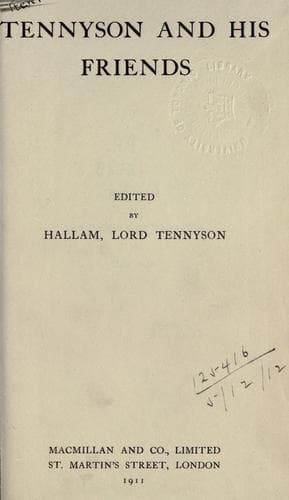
Tennyson, Alfred Tennyson, Baron, 1809-1892 -- Friends and associates
It was my daily habit during the Easter holidays for three years to call
at Farringford at 10.30, and present myself in the Poet's sanctum, where I
found him at his desk in the very act of hatching a poem or amending an
old one. He would greet me with "Here comes my daily bread." Then I read
the newspaper or a book until we started for our morning walk. The
dialogue would begin abruptly, starting from some impressions left by our
musical rehearsals on the previous day. "Why is Stanford unable to set to
music the word 'cosmopolite'?" (See Appendix B.) The reasons seemed to me
quite intelligible, but not so to a poet as fastidious as Wordsworth when
discussing the Installation Ode with Professor Walmisley. I expect Purcell
had more than one bad half-hour with Dryden, for the laws and regulations
of musical accent may often conflict with the cadences and scansion
adopted by the poet. Sir Charles Stanford and Sir Hubert Parry (_lucida
sidera_) are rare instances of musical composers with an instinctive
appreciation of the fitness and adaptability of poetry offered for musical
treatment.
Tennyson was loyal to the core on the subject of his old university, and
amongst his constant visitors were some of my old contemporaries,
Bradshaw, Lightfoot, and Montagu Butler. These, the _fleurs fines_ of my
day, were constant topics, and I eagerly listened to his recollections of
the Cambridge men of his own generation. "Thompson" (afterwards Master of
Trinity), he said, "was the last man I saw at Cambridge. I saw him
standing at the door of the Bull Inn--his handsome face under a street
lamp. We have been friends ever since." He enjoyed the master's
witticisms, and especially "even the youngest among us is not infallible."
The Professorship of Greek carried with it a Canonry of Ely, and
Thompson's times of residence were rather dreaded by the new holders of
the office. His health, never of the best, was tried by the atmosphere,
and finding the loneliness of his bachelor life insupportable, he begged
an old College contemporary to pay him a visit. The friend came and was
duly installed, but the sleeping accommodation was found wanting, and in
answer to his petition for another bedroom with a good fire in it his host
observed, "So sorry, my dear fellow, but I put five of my sermons into
that bedroom, and if they have failed to dry it, nothing else will."
* * * * *
_T._ "My tailor at Cambridge was a man of the name of Law. When he made
his way into our rooms, and worried us about paying our bills, we used to
say, 'This is Law's Serious Call.' I capped this story with a similar
Oxford tradition. The name of the Oxford tailor was Joy, and the
undergraduates, soaked with port wine, used to say, 'Heaviness may endure
for a night, but Joy cometh in the morning.'"
Public-domain text, read in full here on John Shaqi.
Reviews
Reviews
No reviews yet
Be the first to share your thoughts on this work.
Elsewhere in the archive
Join the Discussion
Join the discussion
Sign in to leave a comment or review.
Sign InorCreate an account