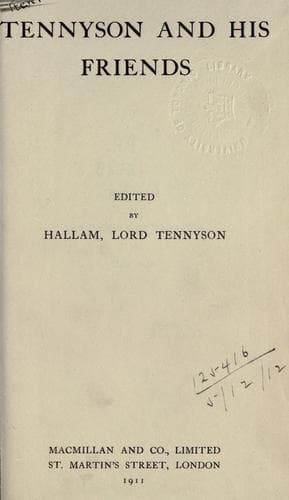
Tennyson, Alfred Tennyson, Baron, 1809-1892 -- Friends and associates
* * * * *
_T._ "My prize poem 'Timbuctoo' was an altered version of a work I had
written at home and called 'The Battle of Armageddon.' I fell out with my
father, for I had no wish to compete for the prize and he insisted on my
writing. To my amazement, the prize was awarded to me. I couldn't face the
public recitation in the Senate House, feeling very much as Cowper felt;
Merivale declaimed my poem for me in the Senate House."
* * * * *
_T._ "Arthur Hallam said to me in 1832: 'To-day I have seen the last
English King going in State to the last English Parliament.'"
* * * * *
I believe that one of Tennyson's first idylls was addressed to Miss K.
Bradshaw, sister of my beloved friend Henry Bradshaw (fellow and librarian
of King's College, Cambridge), whose relationship to the Judge who
condemned Charles I. was rather a tender point with H. B., both at Eton
and King's.
Because she bore the iron name
Of him who doomed his king to die,
I deemed her one of stately frame
And looks to awe her stander by.
But find a maiden, tender, shy,
With fair blue eyes and winning sweet,
And longed to kiss her hand, and lie
A thousand summers at her feet.
* * * * *
I pressed the Poet more than once to put on record his own interpretation
of passages in "In Memoriam" and others which needed the authority of his
own explanation. "Surely you took 'four square to all the winds that blow'
from Dante's
Ben tetragono ai colpi della Ventura?"
"No, it was not in my mind." Again, I quoted his expression, "hollow
shapes enclosing hearts of flame," thinking it had arisen from Beckford's
_Vathek_. The answer was "No, merely spectral visions."
_T._ "Some of my poems depend on single sayings, single lines which have
served me for a theme. My poem of 'The Brigand' is founded on a story told
in the Autobiography of that great and gallant gentleman, Walter Scott."
* * * * *
_T._ "Edward FitzGerald and I used to weary of the hopelessly prosaic
lines in some books of 'The Excursion,' and we had a contest, the prize
for which was to be for the weakest line by mutual consent that we could
either of us invent. FitzGerald declared the line was his--it really was
mine--'A Mr. Wilkinson, a clergyman.'" I wish I could have told him of Jem
Stephen's commentary on "Heaven lies about us in our infancy," "That is no
reason why we should lie about Heaven in our old age." Among other
passages he quotes with admiration Wordsworth's lines on the "Simplon
Pass."
* * * * *
_T._ "I am sorry that I am turned into a school-book at Harrow; the boys
will say of me, 'That horrible Tennyson.' The cheapness of English
classics makes the plan acceptable to schoolmasters and parents."
He quoted with approval Byron's line--
Then farewell, Horace, whom I hated so.
Public-domain text, read in full here on John Shaqi.
Reviews
Reviews
No reviews yet
Be the first to share your thoughts on this work.
Elsewhere in the archive
Join the Discussion
Join the discussion
Sign in to leave a comment or review.
Sign InorCreate an account