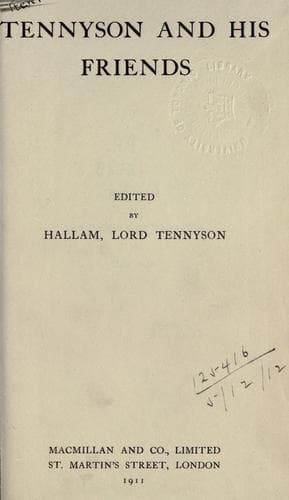
Tennyson, Alfred Tennyson, Baron, 1809-1892 -- Friends and associates
Dante constructed none of this machinery, he used it merely; it
represented the knowledge, that is, the belief, of his time.
Between Dante and Milton there was a gap; but what a gap! It was filled by
Copernicus, Tycho Brahe, Galileo, Columbus, Magellan, and Vasco da Gama,
to mention no more, and the astronomers and geographers between them
smashed the earth-centred heavens, the interior hells, and the earthly
paradise into fragments.
It was while this smashing was working its way into men's minds that
Milton wrote his poem, and he, like Dante, centred it on a cosmogony. Well
might Huxley call it "the Miltonic Hypothesis"! but how different from the
former one, from which it was practically a retreat, carefully concealed
in an important particular, but still a retreat from the old position.
Milton in his poem uses, so far as heaven is concerned, the cosmogony of
Dante, but he carefully puts words into Raphael's mouth to indicate that
after all the earth-centred scheme of the seven heavens must give way. But
the most remarkable part of "Paradise Lost" is the treatment of hell.
Milton's greatness as a poet, as a _maker_, to my mind is justly based
upon the new and vast conceptions which he there gave to the world and to
which the world still clings.
To provide a new hell which had been "dismissed with costs" from the
earth's centre, he boldly halves heaven and creates chaos and an external
hell out of the space he filches from it. "Hellgate" is now the orifice in
the _primum mobile_ towards the empyrean.
In Tennyson we find the complete separation of Science from Dogmatic
Theology, thus foreshadowed by Milton, finally achieved. In him we find,
as in Dante and Milton, one fully abreast with the science and thought of
the time, and after another gap, this one filled up by Newton, Kant,
Herschel, Laplace, and Darwin, we are brought face to face with the modern
Cosmogony based upon science and Evolution. The ideas of heaven and hell
in the mediaeval sense no longer form a necessary part of it, in Tennyson
they have absolutely disappeared. In those parts of his poems in which he
introduces cosmogonic ideas we have to deal with the facts presented by
the heavens and the earth which can throw light upon the ancient history
of our planet and its inhabitants.
The modern _Systema Mundi_ which Tennyson dwells on over and over again is
dominated by
Astronomy and Geology, terrible Muses.
To come back from this parenthesis I must finally point out that although
some of the most pregnant and beautiful passages in Tennyson's poems have
reference to the modern views of the origin of things, almost all natural
phenomena are referred to, in one place or another, in language in which
both the truest poetry and most accurate science are blended.
Public-domain text, read in full here on John Shaqi.
Reviews
Reviews
No reviews yet
Be the first to share your thoughts on this work.
Elsewhere in the archive
Join the Discussion
Join the discussion
Sign in to leave a comment or review.
Sign InorCreate an account