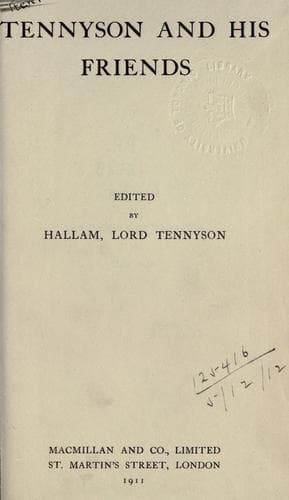
Tennyson, Alfred Tennyson, Baron, 1809-1892 -- Friends and associates
No--once more I saw him, his likeness with all the distinctness sometimes
known in the slow-moving white clouds of some glorious autumn day. It was
after the end had come, and not long before the grave in Westminster Abbey
had received him. I was travelling home on the Great-Western from
Somerset. Gazing up idly at the assembled multitude of sun-steeped silver
clouds above, suddenly, clear and distinct, my eyes beheld the image of
his noble profile as if lying back asleep; the eyes were closed, the head
at rest upon the pillow--a sculptured cloud in a snowy cloudland, outlined
upon an azure sky.... Not until after several minutes did the vision pass,
slowly fading into the infinite blue.
TENNYSON AND HIS TALK ON SOME RELIGIOUS QUESTIONS
By the Right Rev. the BISHOP OF RIPON
Among the happy memories of my life, and they are many, the memory of the
kindly welcome accorded to me at Aldworth and at Farringford must always
possess a special charm. This will readily be understood by those of my
own age; for Tennyson was a name to conjure with in the days of my youth.
Slowly but surely his influence crept into our lives: we read in
text-books at school that the
Poet in a golden age was born, with golden stars above,
Dowered with the hate of hate, the scorn of scorn, the love of love.
The thought and the words appealed to me from the first. Then, how I know
not, we became familiar with part, at least, of "In Memoriam." Its phrases
caught our fancy, and some of our early attempts at versification were
cast in the same metre. Then came the "Idylls of the King," and I remember
how, when the rest of the party went out one holiday afternoon, I stayed
indoors and read the "Idylls" at one sitting. Thus in our youth Tennyson
became poet and hero to us. Any one who had seen him or known him became
for us invested with a kind of sacred and awful interest; my uncle who
lived at Cheltenham grew greater in our eyes when we learned that he had
corresponded with him.
Thus our hero-worship grew. We knew indeed that there were those who did
not welcome the coming Poet with ardour; we lived, in fact, through the
age of his disparagement to the time of his unchallenged supremacy. It
will be interesting, I think, to many to read the following letter written
by Rev. Frederick W. Robertson when he was experiencing the freer and
fresher intellectual atmosphere of Oxford after the stifling
oppressiveness of Cheltenham:
Public-domain text, read in full here on John Shaqi.
Reviews
Reviews
No reviews yet
Be the first to share your thoughts on this work.
Elsewhere in the archive
Join the Discussion
Join the discussion
Sign in to leave a comment or review.
Sign InorCreate an account