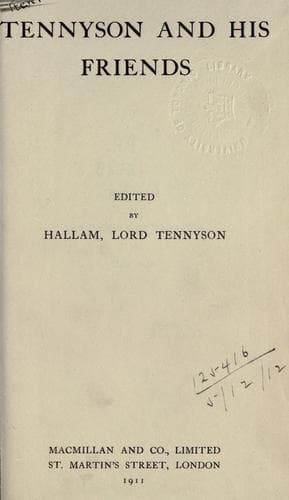
Tennyson, Alfred Tennyson, Baron, 1809-1892 -- Friends and associates
remarked, with superb _naïveté_, "May we remind Mr. Tennyson that the
darkness is past and that the true light now shineth?" I remember, as late
as 1867 or 1868, an evening party at Blackheath when the question was
started--"Who is the greatest living poet?" To my amazement and amusement
a self-satisfied, but very good man, instantly and oracularly replied,
"Bonar--without doubt--Bonar." He meant that excellent and devout-minded
man, the Rev. Horatius Bonar, the hymn-writer. These were, no doubt,
extreme cases, but stupidity is always extreme. I recall these incidents
because they are parts of the story which tells of the difficulties
through which Tennyson fought the way to his throne. They serve to recall
the prejudices which provoked the resentment and stimulated the attachment
of those who, like myself, were brought early under the spell of his
enchantment. His story repeated familiar features; he had at first a
select circle of studious admirers; by degrees the general public became
aware of the existence in their midst of a true poet. Then timid partisans
awoke and demanded credentials of orthodoxy. Persons of this type did not
like to be told that--
There lives more faith in honest doubt,
Believe me, than in half the creeds.
But meanwhile he had drawn the younger generation to his side: they
believed in him, and they were right. In spite of misunderstanding and
misinterpretation, Tennyson followed the gleam: he would not stoop to
make his judgment blind or prevaricate for popularity's sake. He beat his
music out, and those who knew him, as I was privileged to do, during the
later years of his life, could realize how truly he had made a larger
faith his own.
It fell out naturally when I met him that conversation turned on religion
or theological subjects. His mind, courageous, inquiring, honest, sought
truth beyond the forms of truth. On the occasion of my first visit to
Aldworth, in the smoking-room we talked of the problem of pain, of
determinism, of apparent contradictions of faith. That night, indeed, we
seemed to talk--
Of faith, free will, foreknowledge absolute.
Public-domain text, read in full here on John Shaqi.
Reviews
Reviews
No reviews yet
Be the first to share your thoughts on this work.
Elsewhere in the archive
Join the Discussion
Join the discussion
Sign in to leave a comment or review.
Sign InorCreate an account