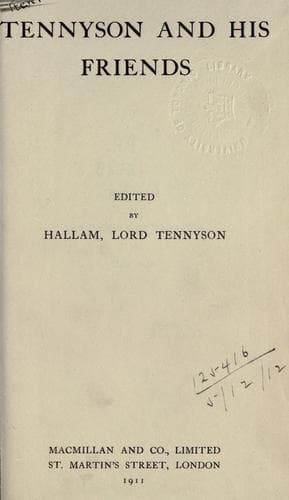
Tennyson, Alfred Tennyson, Baron, 1809-1892 -- Friends and associates
In the grave and solemn stanzas with which the poem opens, he calls the
songs that follow _wild and wandering cries, confusions of a wasted
youth_. But in truth they are the expression of the deepest and most
heartfelt sorrow: the most musical and imaginative outpouring of every
mood, and every trouble, of a noble love and regret: the cries of a soul
stricken with doubt born of anguish, and darkened with shadows of
disbelief and despair: the deeper brooding over the eternal problems of
life, thought, knowledge, religion: the gradual groping toward a faith
rather divined than proved, and slowly passing through storm into peace.
The poem took seventeen years to write, and when it appeared the Poet was
at the summit of his great powers. His instinct chose a metre at once
strong, simple, fresh, flexible, and grave, and noble--equally adapted to
every mood, every form of thought or feeling--the passionate, the
meditative, the solemn, the imaginative--for description, argument,
aspiration, even for prayer. The tone varies: there are lighter and deeper
touches: but it is hardly too much to say, there is not an insignificant
stanza, nor a jarring note, from beginning to end.
In a poem where all is so familiar--which has meant and means so much to
all who care for poetry--it is difficult to quote. I will take a few
stanzas, so chosen, if possible, as to show somewhat of the variety, the
range, the subtlety, the charm, and the power of this great work.
He goes to the house in London where the dead friend lived: the gloom
without typifies and harmonizes with the darkness of his sorrowful
thoughts.
Dark house, by which once more I stand
Here in the long unlovely street:
Doors, where my heart was wont to beat
So quickly, waiting for a hand,--
A hand that can be clasped no more--
Behold me--for I cannot sleep--
And like a guilty thing I creep
At earliest morning to the door.
He is not here; but far away
The noise of life begins again,
And ghastly thro' the drizzling rain
On the bald street breaks the blank day.
One of the most important motives concerns the doubts raised by the new
truths which science was beginning to teach, almost seeming to make in a
sense a new heaven and a new earth. The old simple beliefs seemed to the
Poet threatened--these misgivings are evil dreams: _Nature_ seems to say:
... A thousand types are gone:
I care for nothing, all shall go.
Thou makest thine appeal to me;
I bring to life, I bring to death;
The spirit does but mean the breath:
I know no more...
Then the Poet breaks out:
And he, shall he,
Man, her last work, who seem'd so fair,
Such splendid purpose in his eyes,
Who roll'd the psalm to wintry skies,
Who built him fanes of fruitless prayer--
Who trusted God was love indeed,
And love Creation's final law--
Tho' Nature, red in tooth and claw
With ravine, shriek'd against his creed--
Public-domain text, read in full here on John Shaqi.
Reviews
Reviews
No reviews yet
Be the first to share your thoughts on this work.
Elsewhere in the archive
Join the Discussion
Join the discussion
Sign in to leave a comment or review.
Sign InorCreate an account