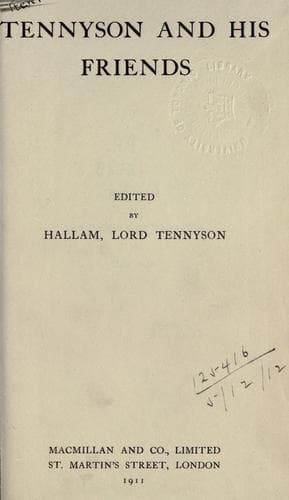
Tennyson, Alfred Tennyson, Baron, 1809-1892 -- Friends and associates
The first idyll, "Gareth and Lynette," is not in itself one of the most
interesting[91]--dealing chiefly as it does with the picture of the eager
boy, anxious to be one of Arthur's knights, who serves a year in menial
place as a test of his obedience: but there is one passage which ought
never to be omitted in speaking of Tennyson, viz. the answer of the seer
when the boys ask him if the castle is enchanted.
The seer answers ironically, yet with a deep meaning, that it _is_
enchanted:
For there is nothing in it as it seems
Saving the King; tho' some there be that hold
The King a shadow, and the city real.
Then he tells them about the _vows_: which if they fear to take, he warns
them
Pass not beneath this gateway, but abide
Without, among the cattle of the field,
For an ye hear a music, like enow
They are building still, seeing the city is built
To music, _therefore never built at all,
And therefore built for ever_.
Beneath the strangely beautiful surface meaning of these lines there lies
the deep allegoric meaning that often what seems visionary is in truth a
spiritual and eternal reality. It brings to mind the wonderful lines of
Browning (in "Abt Vogler"):
The high that proved too high, the heroic for earth too hard,
The passion that left the earth to lose itself in the sky,
Are music sent up to God by the lover and the bard;
Enough that he heard it once, we shall hear it by and by.
The other point concerns the end of the poem. The last section is the
Passing of Arthur; the old fragment "Morte d'Arthur" enlarged. One notable
addition occurs at the very end.
In the earlier version of the fragment, after Arthur had passed away on
the dark lake, with him the last hope also disappears.
We are only told:
Long stood Sir Bedivere,
Revolving many memories, till the hull
Look'd one black dot against the verge of dawn,
And on the mere the wailing died away.
In the fragment the end was tragic: the noble attempt failed; the hero and
inspirer passed away, his aim defeated, his comrades slain or scattered,
his life and efforts vain.
But in the final shape comes a new and very significant end:
Then from the dawn it seem'd there came, but faint,
As from beyond the limit of the world,
Like the last echo born of a great cry,
Sounds, as if some fair city were one voice,
Around a king returning from his wars.
Thereat once more he[92] moved about, and clomb
Ev'n to the highest he could climb--and saw,
Or thought he saw, the speck that bare the King
Somewhere far off, pass on and on, and go
From less to less, and vanish _into light_.
And the new sun rose, bringing the new year.
Public-domain text, read in full here on John Shaqi.
Reviews
Reviews
No reviews yet
Be the first to share your thoughts on this work.
Elsewhere in the archive
Join the Discussion
Join the discussion
Sign in to leave a comment or review.
Sign InorCreate an account