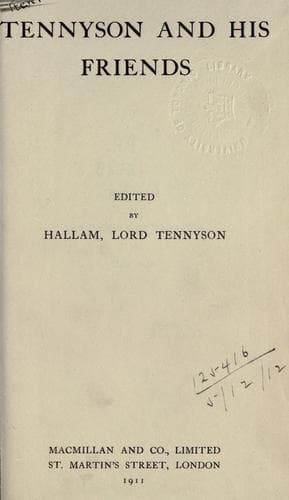
Tennyson, Alfred Tennyson, Baron, 1809-1892 -- Friends and associates
Lord Tennyson has given us a remarkable chronicle of his father's life
from youth to age, illustrated by correspondence that is always
interesting and occasionally of supreme value, by anecdotes and
reminiscences, by characteristic thoughts and pithy observations--the
outcome of the Poet's reflection, consummate literary judgment, and
constant intercourse with the best contemporary intellects. He has,
moreover, so arranged the narrative as to show the rapid expansion of
Tennyson's strong, inborn poetic instinct, with the impressions and
influences which moulded its development, maturing and perfecting his
marvellous powers of artistic execution.
Alfred Tennyson was born in the pastoral village of Somersby, amid the
Lincolnshire wolds; and he spent many holidays on the coast at
Mablethorpe, where he acquired that passion for the sea which has
possessed so many poets. The atmosphere of a public school favours active
emulation and discipline for the outer world; but to a boy of sensitive
and imaginative temperament it is apt to be uncongenial, so we need not be
sorry that Tennyson was spared the experience. At first, like most men of
his temperament who go straight from private tuition to a University, he
felt solitary and depressed--"the country is so disgustingly level, the
revelry of the place so monotonous, the studies of the University so
uninteresting, so matter-of-fact." But there was about him a distinction
in mind and body that soon marked him out among his fellows ("a kind of
Hyperion," writes FitzGerald), uniting strength with refinement, showing
much insight into character, with the faculty of brief and pointed
sallies: "We were looking one day at the portrait of an elderly politician
in bland family aspect. A. T. (with his eyeglass): It looks rather like a
retired panther. So true."[94]
He was an early member of the Society yclept the Apostles, which included
many eager and brilliant spirits, whose debates were upon political
reform, the bettering of the people's condition, upon morals, religion,
and those wider and more liberal views of social needs that were foremost
at a period when the new forces were just mustering for attack upon the
old entrenchment of Church and State. Edward FitzGerald's notes and
Tennyson's own later recollections are drawn upon in this book for lively
illustrations of the sayings and doings of this notable group of friends,
and for glimpses of their manner of life at Cambridge. Here he lived in
the choice society of that day, and formed, among other friendships, an
affectionate attachment to Arthur Hallam, who afterwards became engaged to
his sister, and in whose memory the famous poem was written. Hallam seems
to have been one of those men whose extraordinary promise and early death
invest their brief and brilliant career with a kind of romance, explaining
and almost justifying the pagan notions of Fate and divine envy.
Public-domain text, read in full here on John Shaqi.
Reviews
Reviews
No reviews yet
Be the first to share your thoughts on this work.
Elsewhere in the archive
Join the Discussion
Join the discussion
Sign in to leave a comment or review.
Sign InorCreate an account