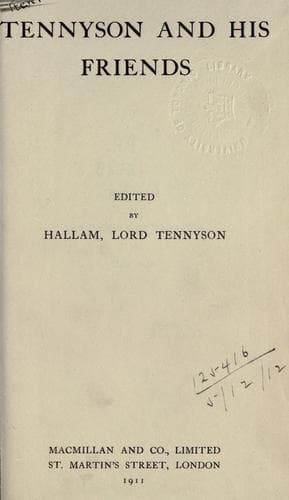
Tennyson, Alfred Tennyson, Baron, 1809-1892 -- Friends and associates
The annals of his daily life, throughout all this later part of it,
consist of extracts from letters, journals, and memorials of intercourse,
which abound with appropriate, amusing, and valuable matter, connected by
the biographer's personal recollections. We have thus a many-coloured
mosaic, in which many figures and characters are reproduced by a kind of
literary tessellation; while, as to the Poet himself, his habits, wise or
whimsical, his thoughts from year to year on the subjects of the day, his
manner of working, are all preserved. The correspondence of his friends
maintains its high level of quality. Mr. W. H. Lecky gives us, in one of
the best among all the reminiscences, a fine sample of his own faculty for
delineation of character, bringing out the Poet's simplicity of soul, his
love of seclusion, the scope of his religious meditations, the keen
sensibility (acquired by long culture) of his rhythmic ear, and also his
susceptibility to the hum and pricking of critics.
Many persons spoke of your father as too much occupied with his
poetry. It did, no doubt, fill a very large place in his thoughts, and
it is also true that he was accustomed to express his opinions about
it with a curiously childlike simplicity and frankness. But at bottom
his nature seemed to be singularly modest. No poet ever corrected so
many lines in deference to adverse criticism. His sensitiveness
seemed to me curiously out of harmony with his large powerful frame,
with his manly dark colouring, with his great massive hands and strong
square-tipped fingers.
His son records how in lonely walks together Tennyson would chant a poem
that he was composing, would search for strange birds or flowers, and
would himself take flight on discovering that he was being stalked by a
tourist. Among the letters is one from Victor Hugo, in the grand
cosmopolitan style, beginning "Mon Éminent et Cher Confrère," professing
love for all mankind and admiration for noble verse everywhere; another
from Cardinal Newman, smooth and adroit; there is also a note by Dr. Dabbs
of his colloquy with Tennyson, showing how he began with the somewhat
musty question about the incompatibility of Science with Religion, and
found the Poet, as we infer, tolerably dexterous with the foils. Renan
called, and put the essence of his philosophy into one phrase, "La vérité
est une nuance"; there are jottings of talks with Carlyle, and a long
extract from the journal of a yachting voyage with Mr. Gladstone, who
said, "No man since Aeschylus could have written the _Bride of
Lammermoor_." It would be doing less than justice to the biography if I
did not choose a few samples from an ample storehouse, and it would be
unfair to make too many quotations, even from a book which surpasses all
recent memoirs as a repertory of characteristic observations and short
views of life and literature, interchanged by speech or writing, with many
notable friends and visitors.
Public-domain text, read in full here on John Shaqi.
Reviews
Reviews
No reviews yet
Be the first to share your thoughts on this work.
Elsewhere in the archive
Join the Discussion
Join the discussion
Sign in to leave a comment or review.
Sign InorCreate an account